
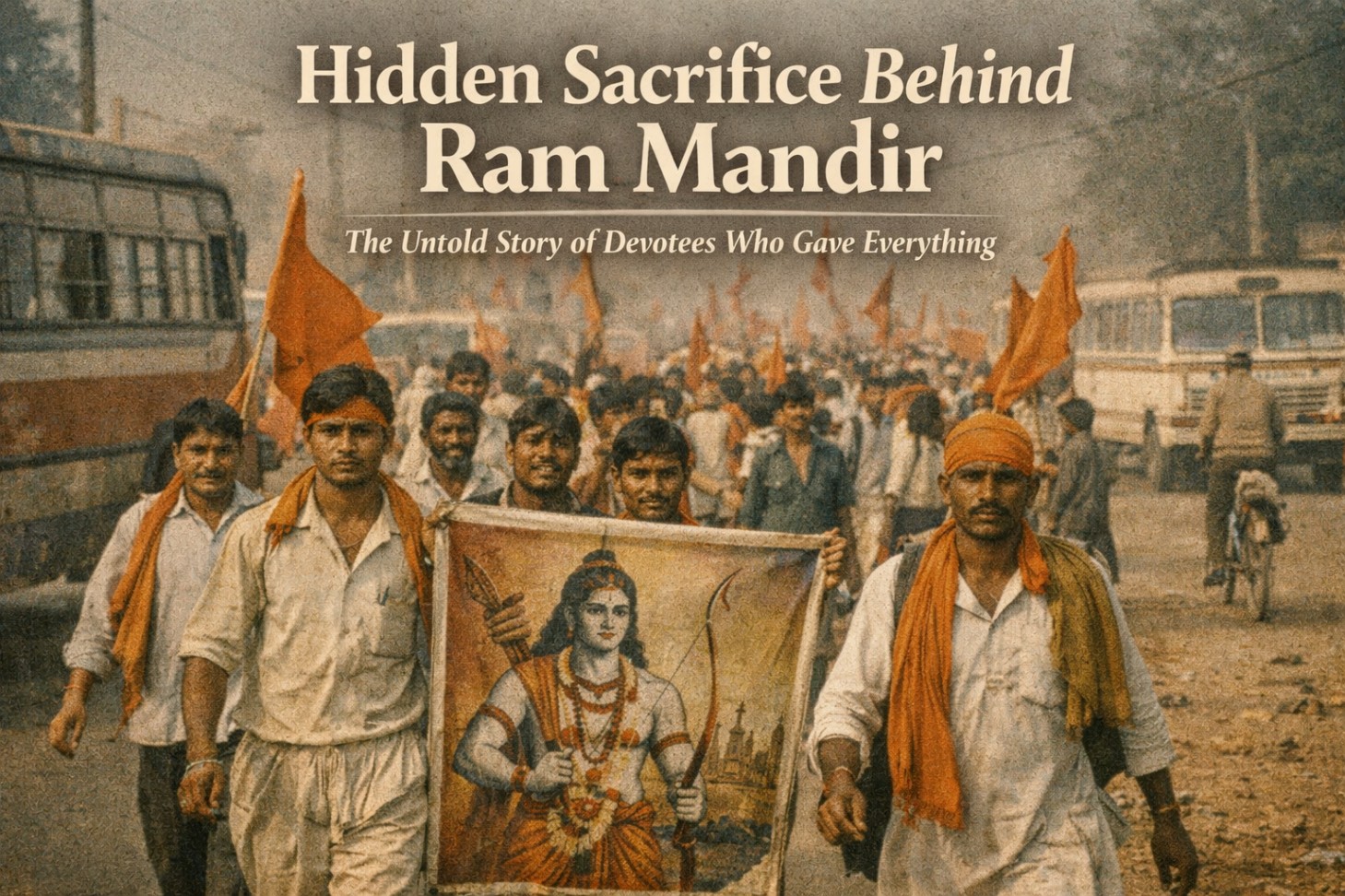
The construction of the grand Ram Mandir in Ayodhya is not only a religious achievement but also a story of faith, patience, and sacrifice. For many devotees of Rama, the temple represents the fulfillment of a centuries-old belief that this sacred place is the birthplace of Lord Ram.
While millions celebrated the temple’s consecration in 2024, the long journey leading to this moment involved countless devotees who struggled, protested, prayed, and in some cases even lost their lives. Their stories form an important part of the history behind the Ram Mandir movement.
Faith in the Birthplace of Lord Ram
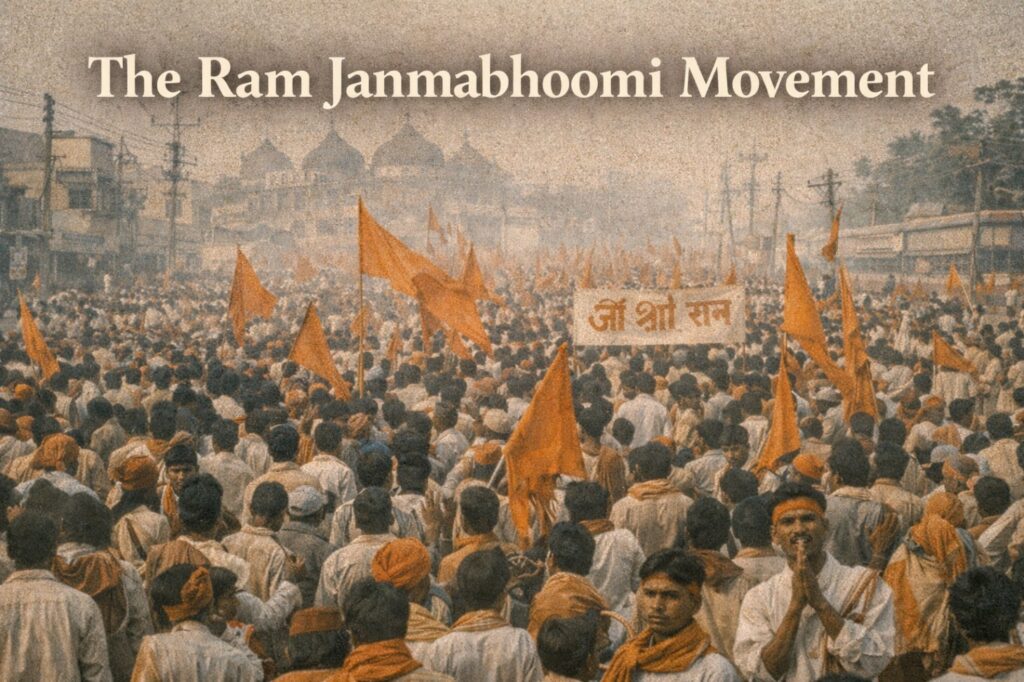
For generations, Hindus have believed that a sacred site in Ayodhya marks the birthplace of Lord Ram. Over time, this location became known as Ram Janmabhoomi.
Historical records show that a mosque called Babri Masjid stood at the disputed site for centuries. Many Hindus believed that a temple marking Lord Ram’s birthplace once existed there earlier. This belief led to a long-standing dispute that continued through the colonial period and after India’s independence.
Despite restrictions and legal disputes, devotees continued to visit the area, offer prayers, and express their devotion to Lord Ram.
The Rise of the Ram Janmabhoomi Movement
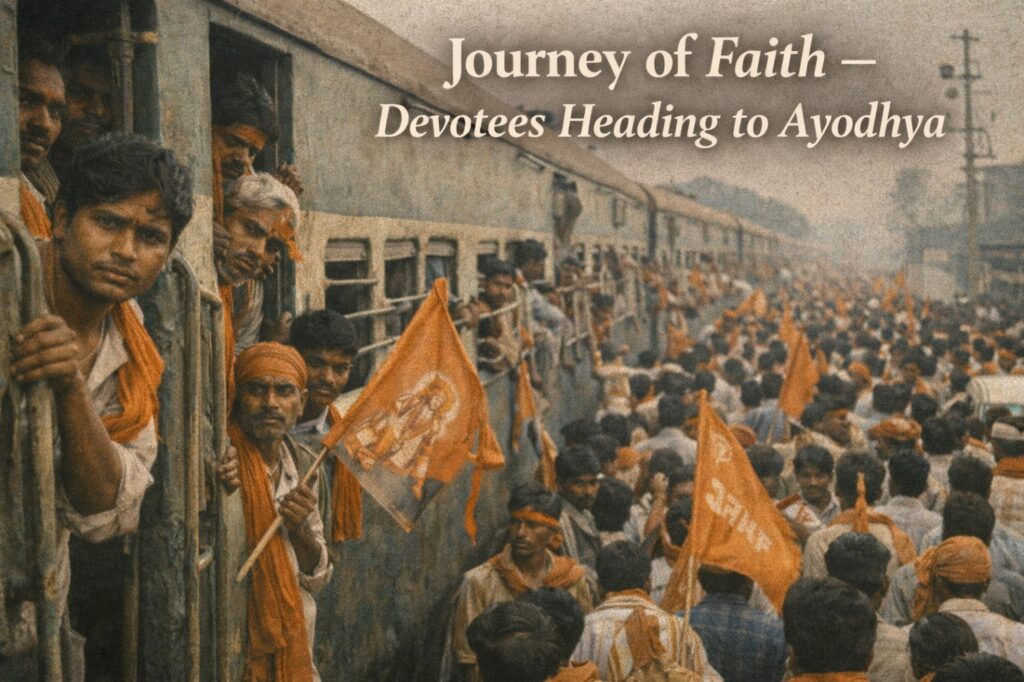
In the 1980s, the demand to build a Ram temple at the Janmabhoomi site began gaining national attention. Religious organizations, spiritual leaders, and many ordinary devotees started supporting the cause.
Groups such as Vishwa Hindu Parishad organized religious gatherings and awareness campaigns. Political support also grew, especially from leaders of the Bharatiya Janata Party.
During this period, thousands of volunteers known as kar sevaks traveled to Ayodhya to offer voluntary service for the temple cause. Many came from distant villages and towns across India, driven by their devotion to Lord Ram.
The 1990 Ayodhya Firing
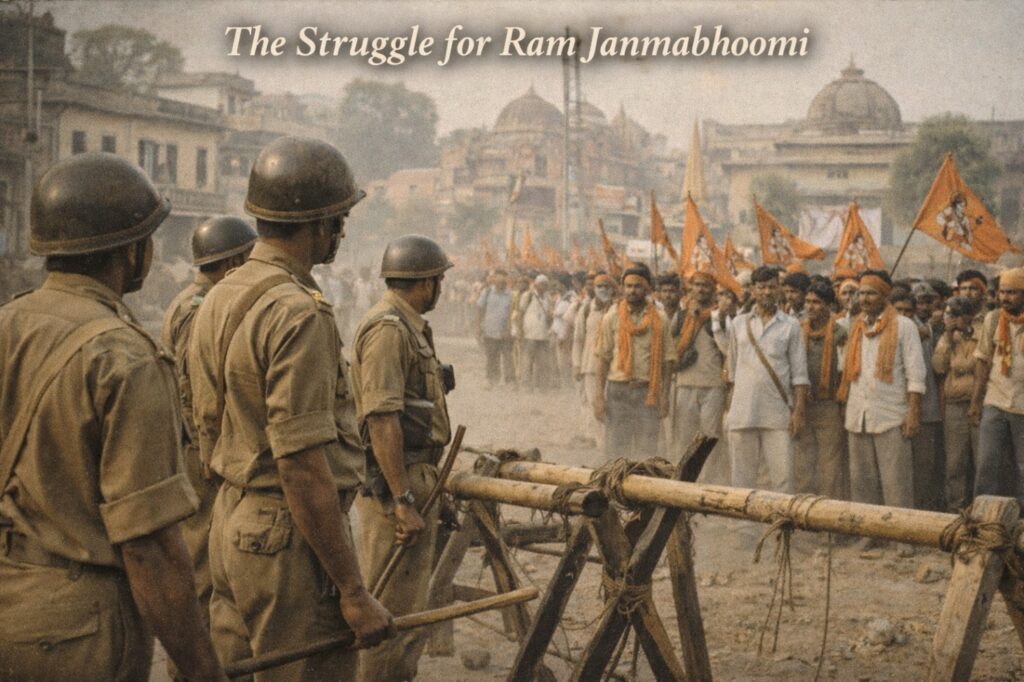
One of the most emotional and controversial moments in the movement occurred in 1990. At that time, the government of Uttar Pradesh attempted to stop kar sevaks from reaching the disputed site.
Despite strict security measures, large numbers of devotees still gathered in Ayodhya. Tensions escalated when police opened fire on protesters near the Ram Janmabhoomi area.
Several kar sevaks lost their lives in the incident. Among the names often remembered by supporters of the movement are the Kothari brothers—Ram Kumar Kothari and Sharad Kumar Kothari—who had traveled from Kolkata to participate in the movement.
For many devotees, these deaths became a symbol of sacrifice for their faith.
The Demolition and Its Aftermath
Another turning point came on 6 December 1992 during the Babri Masjid Demolition. A large crowd gathered at the disputed site and the mosque structure was demolished.
The incident shocked the country and led to widespread unrest in several cities. The government subsequently banned organizations involved in the movement for a period and set up investigations.
For years afterward, the dispute remained one of the most debated issues in Indian politics and society.
A Long Legal Battle
The conflict over the site eventually moved fully into the courts. Several cases related to ownership and religious rights were heard over decades.
The final judgment came in 2019 when the Supreme Court of India delivered a historic verdict. The court awarded the disputed land for the construction of a Ram temple while also directing that another piece of land in Ayodhya be allocated for a mosque.
Following the verdict, the Shri Ram Janmabhoomi Teerth Kshetra was established to oversee the construction of the temple.
The Temple Becomes Reality

Construction of the new Ram temple began soon after the court decision. In January 2024, the Pran Pratishtha ceremony of the idol of Lord Ram was held, marking the beginning of regular worship at the temple.
For millions of devotees, this moment represented the end of a long journey that included faith, patience, legal battles, and personal sacrifices.
Remembering the Devotion Behind the Temple
Today, when visitors walk through the magnificent complex of the Ram Mandir in Ayodhya, they see a symbol of devotion and cultural heritage. But behind the stone pillars and carved architecture lies a deeper story.
It is the story of ordinary devotees who traveled long distances, participated in religious movements, and kept their faith alive during decades of uncertainty.
Their dedication reminds us that the Ram Mandir is not only a temple—it is also a chapter in modern Indian history shaped by faith, struggle, and perseverance.