
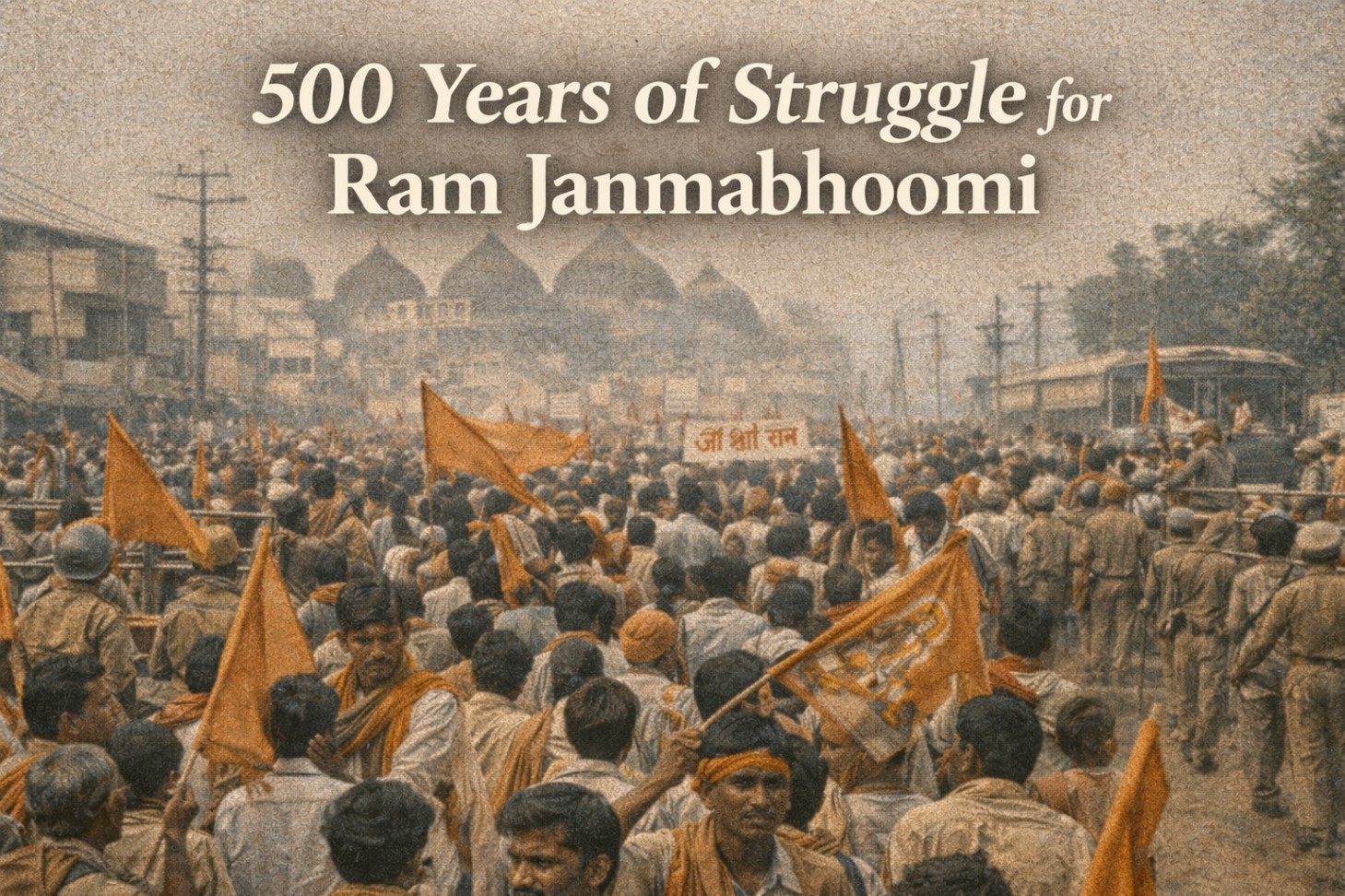
One of the longest religious and legal conflicts in Indian history is the tale of Ram Janmabhoomi in Ayodhya. For millions of devotees of Rama, this place is believed to be the sacred birthplace of Lord Ram.
The construction of the grand Ram Mandir in recent years marked the end of a dispute that lasted nearly five centuries. The journey involved historical conflicts, political movements, legal battles, and the faith of millions of devotees.
The story of Ram Janmabhoomi is not only about history and legal battles, but also about the sacrifices made by thousands of devotees. You can read more about those sacrifices in our article “The Hidden Sacrifice Behind Ram Mandir.”
This blog explores the complete timeline and the major events that shaped the Ram Janmabhoomi movement.
The Origin of the Dispute (16th Century)
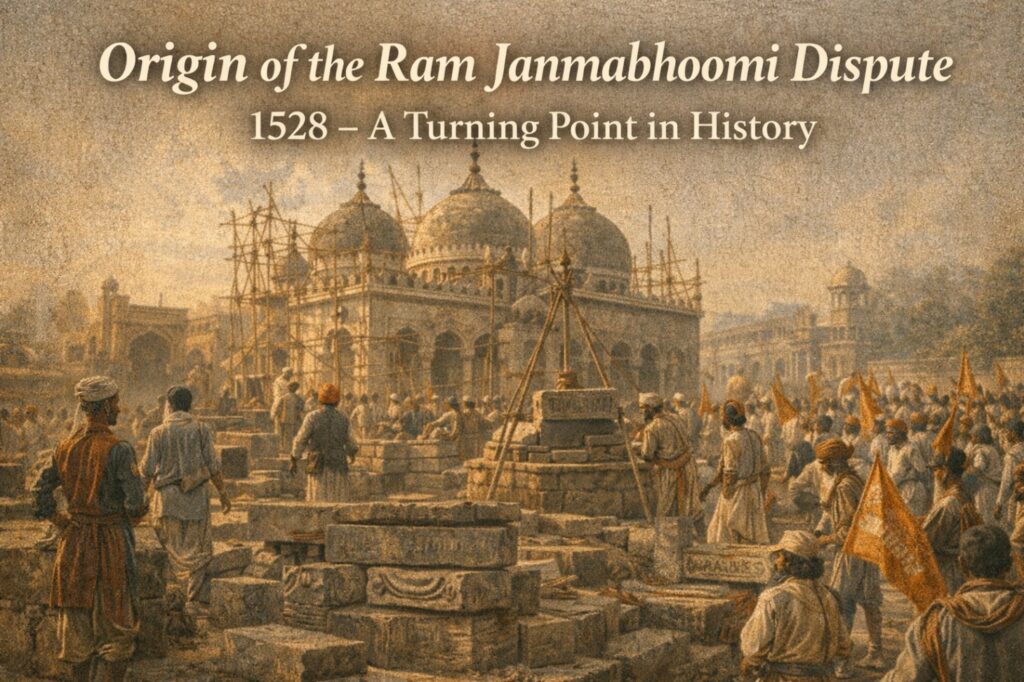
According to historical records and traditional beliefs, a temple marking the birthplace of Lord Ram once existed at the site in Ayodhya.
In 1528, during the reign of Mughal emperor Babur, a mosque known as Babri Masjid was constructed at the location.
Over the centuries, many Hindus believed that the mosque was built over the remains of an earlier temple dedicated to Lord Ram. This belief gradually led to tensions and disputes over the site.
Early Conflicts During the British Era
During the 19th century under the British Raj, several clashes were reported between Hindu and Muslim communities regarding the site.
To manage the dispute, the British administration divided the area in 1859:
-
Hindus were allowed to worship in the outer courtyard.
-
Muslims continued prayers inside the mosque structure.
Although this arrangement reduced direct conflict for some time, the underlying dispute remained unresolved.
The Turning Point of 1949
A major turning point occurred in 1949 when idols of Lord Ram were placed inside the mosque structure at the disputed site.
Following this event:
-
The government declared the area disputed.
-
The gates were locked by authorities.
-
Multiple legal cases were filed by both Hindu and Muslim groups.
For decades, the site remained under legal dispute while devotees continued to demand the construction of a temple.
The Rise of the Ram Janmabhoomi Movement (1980s)
The issue gained national attention in the 1980s when religious organizations began organizing large movements supporting the construction of a Ram temple.
Organizations like Vishwa Hindu Parishad led campaigns to mobilize devotees across India.
Political support also grew, particularly from the Bharatiya Janata Party, which began advocating the temple cause as part of its political agenda.
Thousands of volunteers known as kar sevaks traveled to Ayodhya to support the movement.
The 1990 Kar Seva and Police Firing
In 1990, thousands of Ram devotees gathered in Ayodhya to participate in kar seva (voluntary service).
At that time, the Uttar Pradesh government attempted to prevent devotees from reaching the disputed site. Security forces were deployed and clashes broke out between police and protesters.
Police opened fire during the confrontation, and several kar sevaks were killed. Among those remembered by many supporters of the movement were the Kothari brothers—Ram Kumar Kothari and Sharad Kumar Kothari.
These incidents intensified the emotions surrounding the Ram Janmabhoomi movement.
From Babri Masjid to Ram Mandir: The Ayodhya Timeline
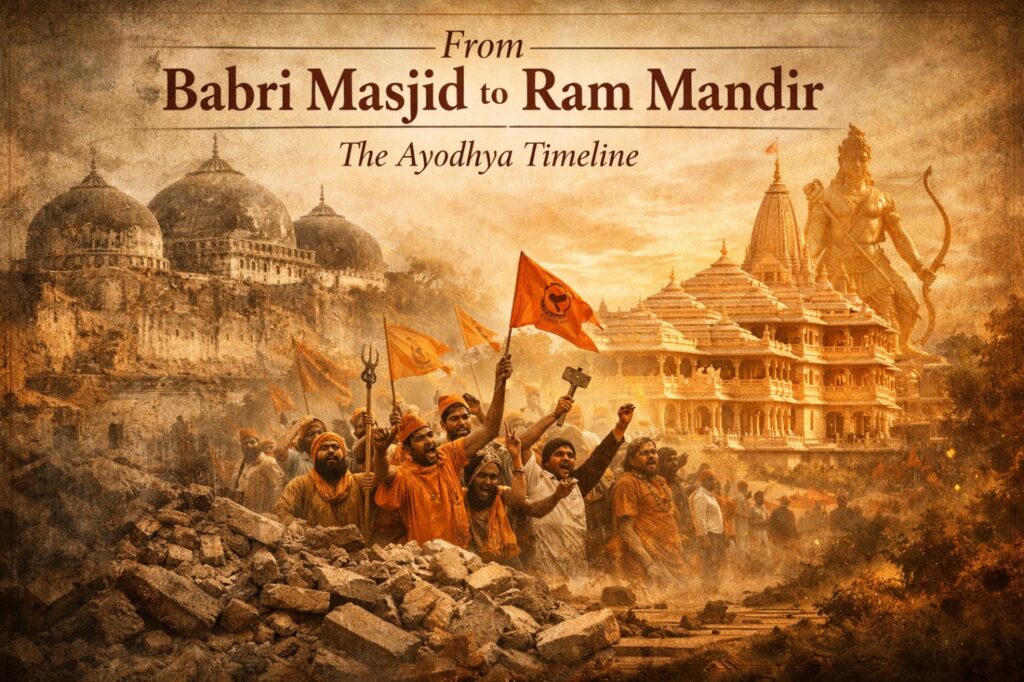
One of the most dramatic events in the history of the dispute occurred on 6 December 1992 during the Babri Masjid Demolition.
On that day:
-
A large crowd of kar sevaks gathered in Ayodhya.
-
The Babri Masjid structure was demolished.
-
The incident triggered widespread unrest and debates across India.
Following the demolition:
-
The central government took control of the disputed land.
-
Several investigations and court cases were initiated.
-
The matter moved into a long legal battle that lasted decades.
For years, the site remained under heavy security while legal proceedings continued.
How the Supreme Court of India Resolved the Ram Janmabhoomi Dispute
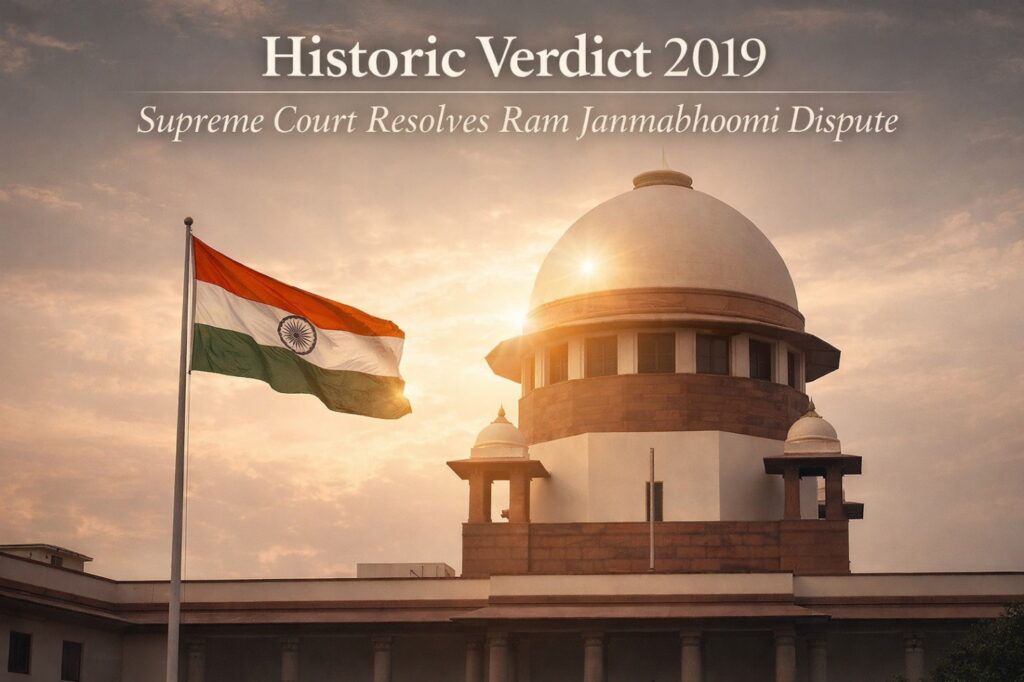
After decades of legal battles, the final decision came from the Supreme Court of India in November 2019.
The court delivered a unanimous verdict after examining historical documents, archaeological evidence, and legal claims.
The judgment stated:
-
The disputed land would be given for the construction of a Ram temple.
-
A separate plot of land would be provided to the Muslim community for building a mosque in Ayodhya.
Following the verdict, the government established the Shri Ram Janmabhoomi Teerth Kshetra to oversee the temple construction.
Construction of the Ram Mandir
After the court’s decision, construction of the grand temple began.
The temple is being built with traditional Indian temple architecture and is expected to become one of the largest Hindu temples in the world.
In January 2024, the Pran Pratishtha ceremony was held, marking the installation of the idol of Lord Ram in the temple.
For millions of devotees, this moment symbolized the completion of a struggle that lasted centuries.
The Legacy of a 500-Year Journey
The story of Ram Janmabhoomi is not just about a legal dispute or political movement. It represents a long journey shaped by faith, devotion, and the determination of millions of people.
Today, the Ram Mandir in Ayodhya stands as a symbol of religious devotion and cultural heritage.
For many devotees, the temple represents the fulfillment of a dream passed down through generations—a dream connected to the sacred birthplace of Lord Ram.