
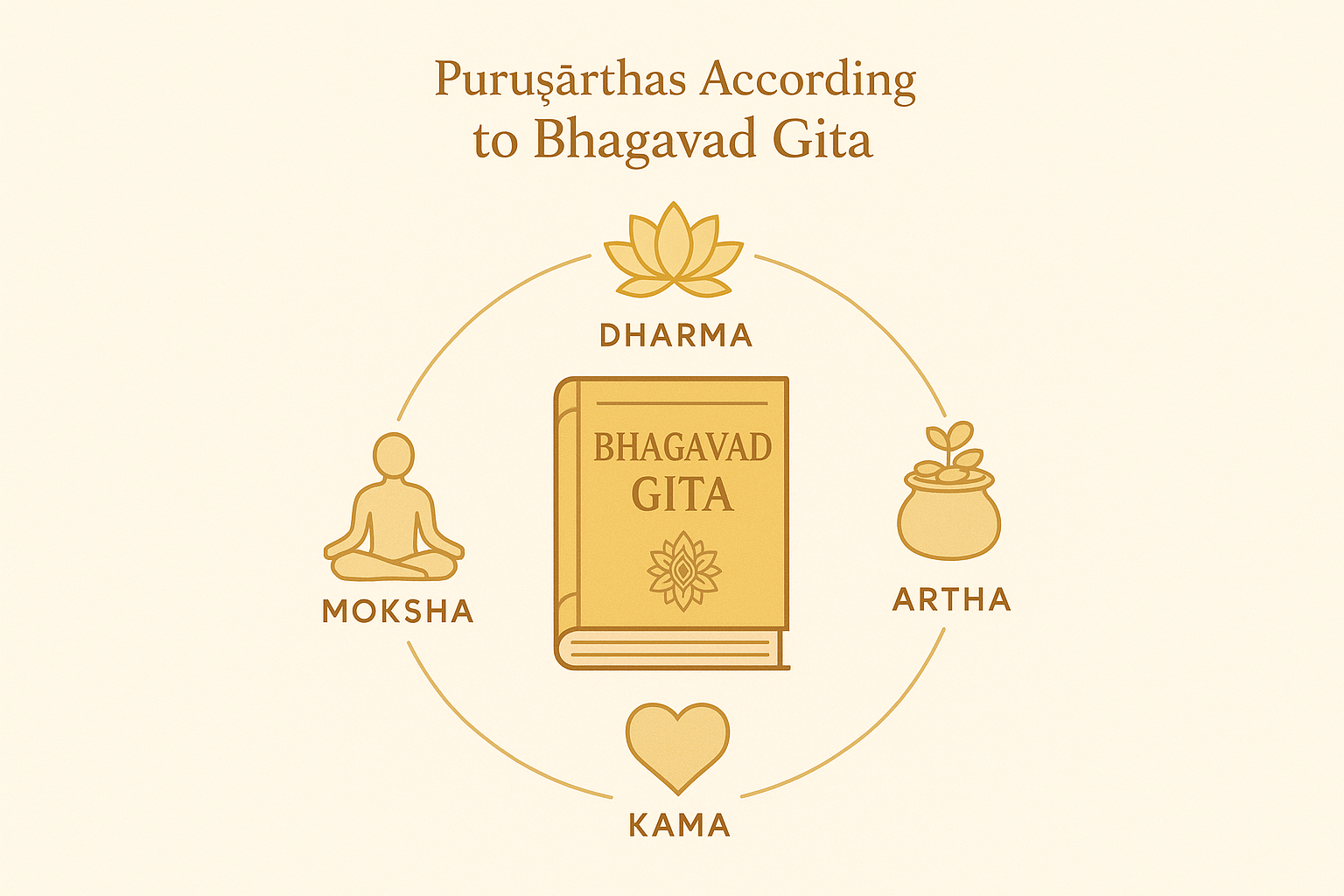
The ancient wisdom of the Bhagavad Gita offers guidance for every stage of life. One of its most beautiful teachings is the idea of Puruṣārthas — the four essential goals of human life. These goals help us live with purpose, balance, and inner peace.
In this beginner-friendly guide, let’s understand how the Gita explains Dharma, Artha, Kama, and Moksha in a modern, relatable way.
🌿 What Are the Four Puruṣārthas?
The word Puruṣārtha means “the purpose of human life.”
According to the Gita and other Vedic texts, a complete and meaningful life includes four dimensions:
-
Dharma – living with integrity and responsibility
-
Artha – earning and managing wealth in the right way
-
Kama – healthy desires, love, joy, and emotional fulfillment
-
Moksha – spiritual freedom and liberation
Let’s explore each one through the lens of the Bhagavad Gita.
🕉️ 1. Dharma – The Right Way of Living

Dharma is the foundation of all spiritual progress.
In the Gita, Krishna repeatedly reminds Arjuna to follow his duty — not out of pressure, but out of love and clarity.
👉 What Dharma Means for Us Today
-
Doing your responsibilities honestly
-
Making choices that are ethical and kind
-
Standing up for truth even in discomfort
-
Balancing personal needs with the greater good
Gita Insight:
“Better to do your own duty imperfectly, than to do someone else’s perfectly.”
This teaches us that Dharma is personal — stay true to your role, your values, and your journey.
💰 2. Artha – Wealth with Purpose

Artha refers to material stability — money, resources, security, and opportunities.
The Bhagavad Gita never rejects wealth. Instead, it teaches:
👉 Wealth becomes spiritual when:
-
It is earned honestly
-
It is used responsibly
-
It supports your Dharma
-
It helps family, society, and spiritual growth
Artha is not greed; it’s the support system that allows us to live well and serve well.
❤️ 3. Kama – Desires and Joy in the Right Measure

Kama includes love, pleasure, relationships, creativity, and emotional happiness.
The Gita never says desire is wrong. It teaches balanced desire.
👉 Healthy Kama means:
-
Choosing relationships that uplift you
-
Enjoying life without losing self-control
-
Pursuing passions without attachment
-
Letting joy flow naturally, not forcibly
Kama becomes a problem only when it controls us.
The Gita teaches us to enjoy life with awareness, not obsession.
🌼 4. Moksha – Freedom of the Soul

Moksha is the ultimate goal — inner freedom, peace, and connection with the Divine.
The Bhagavad Gita explains Moksha beautifully:
👉 According to the Gita, Moksha comes by:
-
Understanding that the soul (Atman) is eternal
-
Letting go of ego and selfishness
-
Performing duties without attachment
-
Surrendering to the Divine with love
-
Practicing Bhakti, Dhyana, and self-awareness
Moksha is not escaping life.
It is living so purely and peacefully that nothing outside can disturb your inner space.
Moksha is the experience of:
“I am not just this body or mind — I am the eternal soul.”
🌺 How the Four Puruṣārthas Work Together
The Gita teaches balance.
Dharma guides Artha.
Artha supports Kama.
Kama must stay within Dharma.
And all three prepare the mind for Moksha.
They are not separate goals — they are a complete map for human life.
When aligned, life becomes peaceful, meaningful, and spiritually fulfilling.
🧘 A Modern Take – How to Apply Puruṣārthas Today
Here are simple ways to live these principles in daily life:
✔ Live responsibly (Dharma)
Choose honesty and kindness.
✔ Use money wisely (Artha)
Earn well, save well, and give back.
✔ Enjoy joys mindfully (Kama)
Build loving relationships and pursue meaningful passions.
✔ Spend time in spiritual practices (Moksha)
Meditation, mantra jaap, satsang, and reading the Gita.
Even a few minutes of daily sadhana can slowly shift you toward Moksha.
🌟 Conclusion
The Bhagavad Gita does not ask us to run away from life.
It teaches us to live life fully — with purpose, joy, prosperity, and spiritual depth.
Understanding the four Puruṣārthas is the first step toward a balanced, meaningful, and enlightened life.