
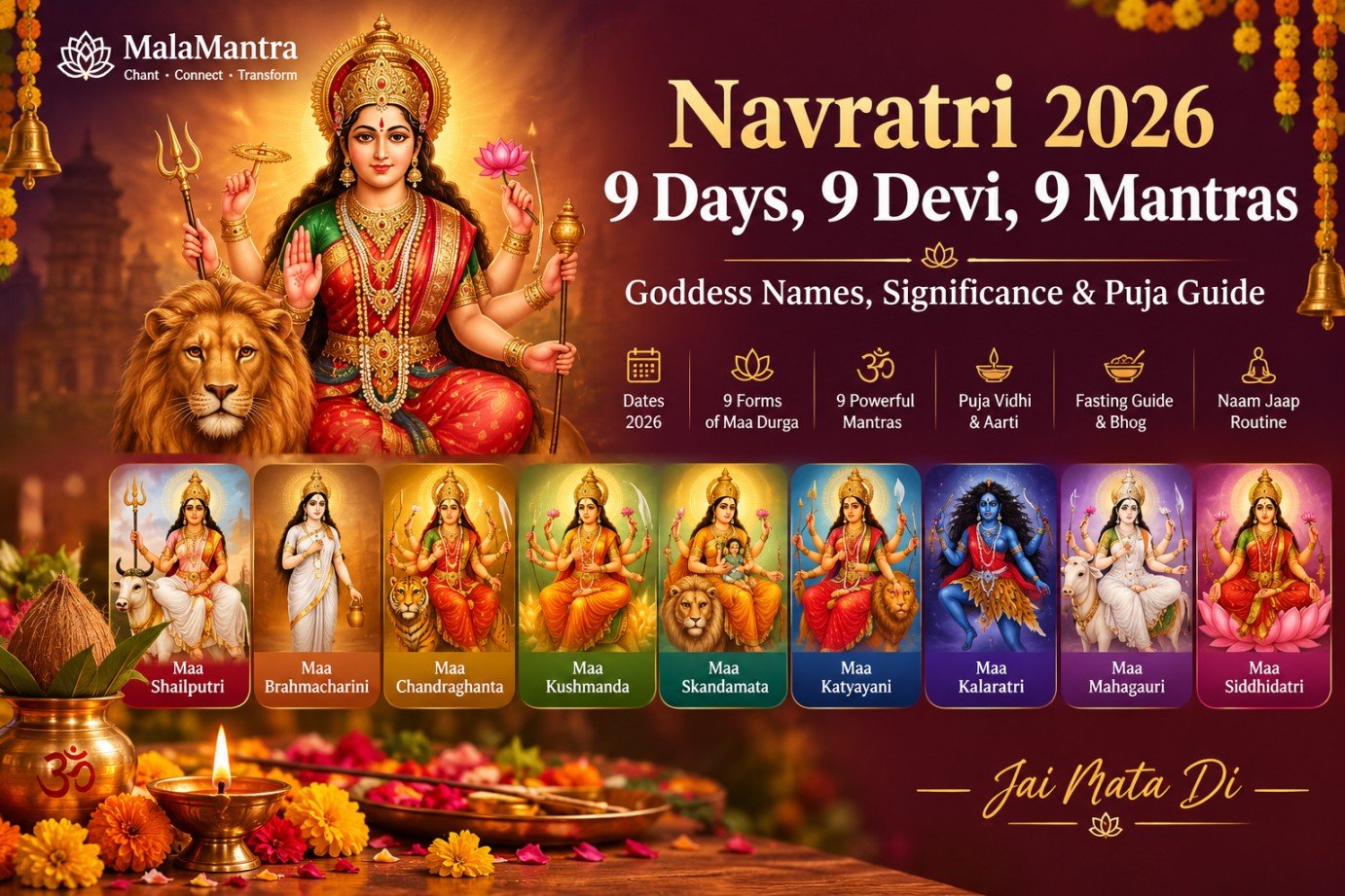
Navratri 2026 is a nine-night Hindu festival dedicated to the worship of Goddess Durga and her nine forms, traditionally known as the Navdurga. During these nine days, devotees pray to a different form of Maa Durga each day, perform puja, observe fasting according to their tradition, and chant Devi mantras.
In 2026, Sharad Navratri begins on Sunday, October 11, and continues through Monday, October 19. Vijayadashami (Dussehra) falls on Tuesday, October 20. The first day is associated with Ghatasthapana and the worship of Maa Shailputri.
This Navratri guide explains the 9 days of Navratri, 9 forms of Goddess Durga, their significance, simple mantras, puja practices and a daily naam jaap routine.
Navratri 2026 Dates at a Glance
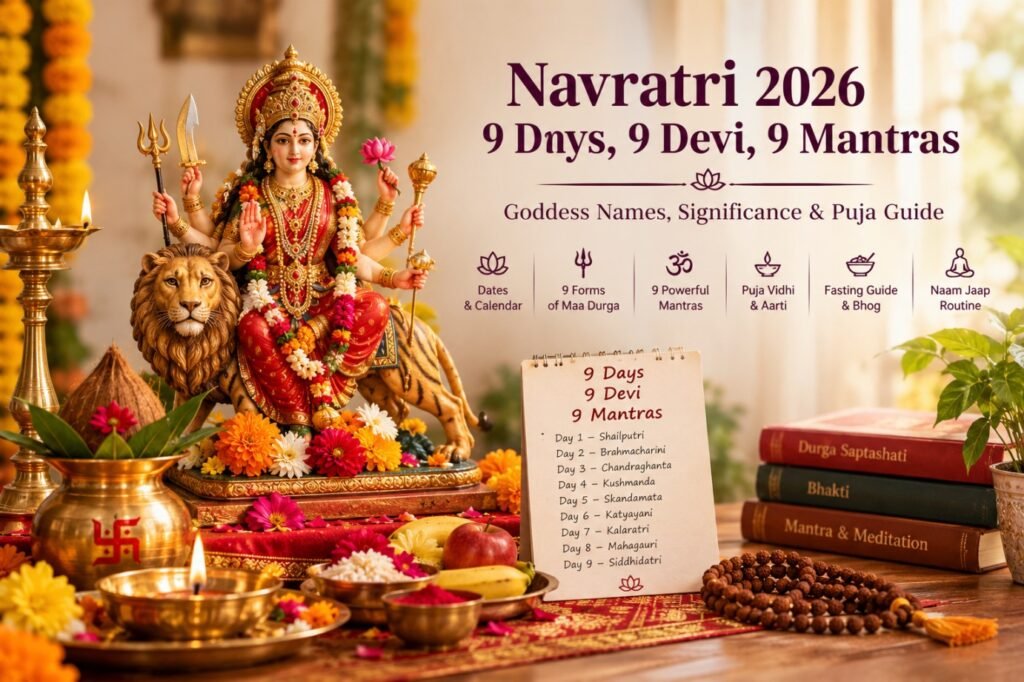
| Navratri Day | Date | Goddess | Tithi |
|---|---|---|---|
| Day 1 | October 11, 2026 | Maa Shailputri | Pratipada |
| Day 2 | October 12, 2026 | Maa Brahmacharini | Dwitiya |
| Day 3 | October 13, 2026 | Maa Chandraghanta | Tritiya |
| Day 4 | October 14, 2026 | Maa Kushmanda | Chaturthi |
| Day 5 | October 15, 2026 | Maa Skandamata | Panchami |
| Day 6 | October 16, 2026 | Maa Katyayani | Shashthi |
| Day 7 | October 17, 2026 | Maa Kalaratri | Saptami |
| Day 8 | October 18, 2026 | Maa Mahagauri | Ashtami |
| Day 9 | October 19, 2026 | Maa Siddhidatri | Navami |
| Vijayadashami | October 20, 2026 | — | Dashami |
The dates above follow the 2026 Sharad Navratri calendar for India. Local panchang details and puja timings can differ by city.
What Is Navratri?
The word Navratri comes from two Sanskrit words: “Nav” meaning nine and “Ratri” meaning night. Sharad Navratri is observed during the Hindu month of Ashwin and is dedicated to nine forms of Goddess Shakti.
The nine forms are collectively called Navdurga:
- Maa Shailputri
- Maa Brahmacharini
- Maa Chandraghanta
- Maa Kushmanda
- Maa Skandamata
- Maa Katyayani
- Maa Kalaratri
- Maa Mahagauri
- Maa Siddhidatri
Each form represents a different aspect of divine feminine energy. Devotees may use these nine days for prayer, meditation, fasting, seva and naam jaap.
Day 1 – Maa Shailputri
Date: October 11, 2026
The first day of Navratri is dedicated to Maa Shailputri. She is traditionally described as the daughter of the Himalayas. Her name means “daughter of the mountain.”
Maa Shailputri is associated with strength, stability, purity and devotion. On the first day, devotees traditionally begin Navratri worship with Ghatasthapana or Kalash Sthapana, according to their family and regional traditions.
Maa Shailputri Mantra
ॐ देवी शैलपुत्र्यै नमः।
Om Devi Shailputryai Namah.
You can chant this mantra during your morning or evening puja.
Day 1 Naam Jaap
Sit comfortably before the puja altar and chant the Maa Shailputri mantra 11, 21 or 108 times.
Day 2 – Maa Brahmacharini
Date: October 12, 2026
The second day is dedicated to Maa Brahmacharini. Her form represents devotion, penance, determination and spiritual discipline.
This day can be used as an opportunity to focus on inner peace and consistency in spiritual practice.
Maa Brahmacharini Mantra
ॐ देवी ब्रह्मचारिण्यै नमः।
Om Devi Brahmacharinyai Namah.
Day 2 Naam Jaap
After lighting a diya, sit quietly and chant the mantra while keeping your attention on the name and form of Maa Brahmacharini.
Day 3 – Maa Chandraghanta
Date: October 13, 2026
The third day is dedicated to Maa Chandraghanta. She is traditionally depicted with a crescent moon resembling a bell on her forehead.
Her form is associated with courage, protection and peace. Devotees remember Maa Chandraghanta while seeking strength to face difficulties with courage.
Maa Chandraghanta Mantra
ॐ देवी चन्द्रघण्टायै नमः।
Om Devi Chandraghantayai Namah.
Day 3 Naam Jaap
Chant the mantra slowly and clearly. You can use a 108-bead jaap mala if that is part of your regular spiritual practice.
Day 4 – Maa Kushmanda
Date: October 14, 2026
The fourth day is dedicated to Maa Kushmanda. Her name and traditional descriptions connect her with cosmic energy and creation.
Devotees worship Maa Kushmanda for positivity, vitality and divine strength.
Maa Kushmanda Mantra
ॐ देवी कूष्माण्डायै नमः।
Om Devi Kushmandayai Namah.
Day 4 Naam Jaap
Take a few quiet minutes before your puja and repeat the mantra with devotion. The purpose of naam jaap is to keep the mind focused and connected with the chosen deity.
Day 5 – Maa Skandamata
Date: October 15, 2026
The fifth day is dedicated to Maa Skandamata, traditionally regarded as the mother of Lord Skanda, also known as Kartikeya.
Her form represents motherhood, compassion and protective divine energy.
Maa Skandamata Mantra
ॐ देवी स्कन्दमात्रे नमः।
Om Devi Skandamatre Namah.
Day 5 Naam Jaap
Devotees can chant the mantra while praying for peace, family well-being and spiritual strength.
Day 6 – Maa Katyayani
Date: October 16, 2026
The sixth day is dedicated to Maa Katyayani, one of the powerful forms of Goddess Durga.
Maa Katyayani is traditionally associated with courage, protection and the removal of obstacles.
Maa Katyayani Mantra
ॐ देवी कात्यायन्यै नमः।
Om Devi Katyayanyai Namah.
Day 6 Naam Jaap
Chant the mantra 11, 21 or 108 times according to your personal practice. You can also spend a few minutes in silent meditation after the jaap.
Day 7 – Maa Kalaratri
Date: October 17, 2026
The seventh day is dedicated to Maa Kalaratri, the fierce form of Goddess Durga.
Although her appearance is traditionally described as fierce, she is worshipped as a protective form of Shakti. Her worship is associated with courage, fearlessness and overcoming darkness.
Maa Kalaratri Mantra
ॐ देवी कालरात्र्यै नमः।
Om Devi Kalaratryai Namah.
Day 7 Naam Jaap
Keep the environment peaceful and focus on the mantra rather than rushing through the repetitions.
Day 8 – Maa Mahagauri
Date: October 18, 2026
The eighth day, Durga Ashtami, is associated with Maa Mahagauri.
Maa Mahagauri is traditionally associated with purity, peace and spiritual cleansing. Many devotees consider Ashtami an important day for special Devi worship.
Maa Mahagauri Mantra
ॐ देवी महागौर्यै नमः।
Om Devi Mahagauryai Namah.
Day 8 Naam Jaap
Chant the mantra with a calm mind and offer simple flowers, fruits or prasad according to your family tradition.
Day 9 – Maa Siddhidatri
Date: October 19, 2026
The ninth day is dedicated to Maa Siddhidatri. She is traditionally associated with spiritual accomplishment, wisdom and divine perfection.
Navami marks the completion of the nine-day worship of the Navdurga.
Maa Siddhidatri Mantra
ॐ देवी सिद्धिदात्र्यै नमः।
Om Devi Siddhidatryai Namah.
Day 9 Naam Jaap
Complete the nine-day practice by chanting Maa Siddhidatri’s mantra with gratitude and devotion.
9 Navratri Mantras at a Glance
If you want a simple list to save or follow during Navratri, here are all nine mantras together:
Day 1 – Maa Shailputri
ॐ देवी शैलपुत्र्यै नमः।
Day 2 – Maa Brahmacharini
ॐ देवी ब्रह्मचारिण्यै नमः।
Day 3 – Maa Chandraghanta
ॐ देवी चन्द्रघण्टायै नमः।
Day 4 – Maa Kushmanda
ॐ देवी कूष्माण्डायै नमः।
Day 5 – Maa Skandamata
ॐ देवी स्कन्दमात्रे नमः।
Day 6 – Maa Katyayani
ॐ देवी कात्यायन्यै नमः।
Day 7 – Maa Kalaratri
ॐ देवी कालरात्र्यै नमः।
Day 8 – Maa Mahagauri
ॐ देवी महागौर्यै नमः।
Day 9 – Maa Siddhidatri
ॐ देवी सिद्धिदात्र्यै नमः।
How to Do Navratri Puja at Home
Navratri puja can be performed in different ways depending on family customs and regional traditions. A simple home puja can include the following steps:
1. Clean the Puja Space
Clean the place where you will perform the puja and arrange the necessary items.
2. Light a Diya
Light a diya before beginning your prayer. Keep the diya safely on a stable surface.
3. Place the Image or Idol of Maa Durga
Place an image or idol of Goddess Durga or the Devi being worshipped that day.
4. Offer Flowers
Offer fresh flowers according to your family tradition.
5. Offer Prasad
Fruits or a simple sattvic offering can be offered as prasad.
6. Chant the Devi Mantra
Chant the mantra of the day’s Devi. You may repeat it 11, 21, 51 or 108 times.
7. Perform Aarti
Complete the puja with Devi aarti or a prayer according to your family tradition.
8. Sit for Naam Jaap
After the aarti, spend a few minutes quietly chanting the Devi’s name or mantra.
Navratri Naam Jaap: A Simple 9-Day Practice
Navratri is a meaningful time to build a consistent naam jaap routine.
You do not necessarily need a complicated ritual. A simple daily practice can be:
Morning or evening → Diya → Devi mantra → 108 repetitions → Short prayer
If you use a jaap mala, keep your attention on each repetition and avoid rushing through the mantra.
For beginners, even 11 or 21 repetitions can be a simple way to start. The important part is maintaining a peaceful and focused practice.
Navratri Fasting and Food
Many devotees observe a fast during Navratri, while others follow a regular sattvic diet. Fasting practices vary considerably between families and regions.
Commonly eaten vrat foods may include:
- Sabudana
- Kuttu
- Singhara flour
- Samak rice
- Potatoes
- Fruits
- Milk and dairy products
- Nuts and dry fruits
The exact fasting rules differ according to personal, family and regional traditions. If you are fasting, follow the practice appropriate for your health and circumstances.
What Is Special About Ashtami and Navami?
Durga Ashtami and Navami are important days during Sharad Navratri.
Ashtami is associated with the worship of Maa Mahagauri, while Navami is associated with Maa Siddhidatri in the Navdurga tradition. Many families also perform Kanya Puja or Kanjak Puja around Ashtami or Navami, depending on their local tradition.
In 2026, Durga Ashtami falls on October 18, followed by Navami on October 19. Vijayadashami follows on October 20.
Navratri and Vijayadashami
The nine nights of Navratri conclude with Vijayadashami, also known as Dussehra.
The festival is associated with the victory of good over evil and is celebrated in different ways across India. In many traditions, Vijayadashami marks the conclusion of the Navratri period.
In 2026, Vijayadashami falls on October 20.
Why Chant Devi Mantras During Navratri?
Mantra chanting is an important part of many Hindu spiritual practices. During Navratri, devotees use the nine-day period to remember Goddess Durga and her different forms through prayer and naam jaap.
Regular chanting can also provide a structured period of quiet reflection and devotion.
Rather than focusing only on the number of repetitions, try to chant with attention and understand the Devi you are worshipping that day.
9 Days, 9 Devi, 9 Mantras – Quick Guide
Day 1: Maa Shailputri – Strength and stability
Mantra: ॐ देवी शैलपुत्र्यै नमः।
Day 2: Maa Brahmacharini – Devotion and discipline
Mantra: ॐ देवी ब्रह्मचारिण्यै नमः।
Day 3: Maa Chandraghanta – Courage and protection
Mantra: ॐ देवी चन्द्रघण्टायै नमः।
Day 4: Maa Kushmanda – Energy and creation
Mantra: ॐ देवी कूष्माण्डायै नमः।
Day 5: Maa Skandamata – Motherhood and compassion
Mantra: ॐ देवी स्कन्दमात्रे नमः।
Day 6: Maa Katyayani – Courage and protection
Mantra: ॐ देवी कात्यायन्यै नमः।
Day 7: Maa Kalaratri – Fearlessness and protection
Mantra: ॐ देवी कालरात्र्यै नमः।
Day 8: Maa Mahagauri – Purity and peace
Mantra: ॐ देवी महागौर्यै नमः।
Day 9: Maa Siddhidatri – Wisdom and spiritual accomplishment
Mantra: ॐ देवी सिद्धिदात्र्यै नमः।
Final Thoughts
Navratri is more than a nine-day festival. For many devotees, it is a period of prayer, discipline, devotion and remembrance of Maa Durga in her nine forms.
Whether you observe a fast, perform a traditional puja, visit a temple or simply spend a few minutes doing naam jaap, the nine days can become an opportunity to slow down and connect with your spiritual practice.
Choose the Devi of the day, chant her mantra with attention and spend a few peaceful moments in prayer.
Jai Mata Di.
Frequently Asked Questions About Navratri 2026
When does Navratri start in 2026?
Sharad Navratri 2026 begins on October 11, 2026, with the first day dedicated to Maa Shailputri and Ghatasthapana.
When is Navratri Ashtami in 2026?
Durga Ashtami falls on October 18, 2026. Maa Mahagauri is worshipped on the eighth day in the Navdurga tradition.
When is Navami in 2026?
Navami falls on October 19, 2026, and is associated with Maa Siddhidatri.
When is Vijayadashami in 2026?
Vijayadashami, or Dussehra, falls on October 20, 2026.
What are the 9 forms of Goddess Durga?
The nine forms are Maa Shailputri, Maa Brahmacharini, Maa Chandraghanta, Maa Kushmanda, Maa Skandamata, Maa Katyayani, Maa Kalaratri, Maa Mahagauri and Maa Siddhidatri.
Which mantra should I chant during Navratri?
You can chant the mantra associated with the Devi worshipped on that particular day. Chanting it 11, 21 or 108 times can be incorporated into a personal naam jaap practice.
Can I do Navratri naam jaap at home?
Yes. A simple home practice can include lighting a diya, remembering the Devi of the day, chanting her mantra and ending with a short prayer or aarti.