
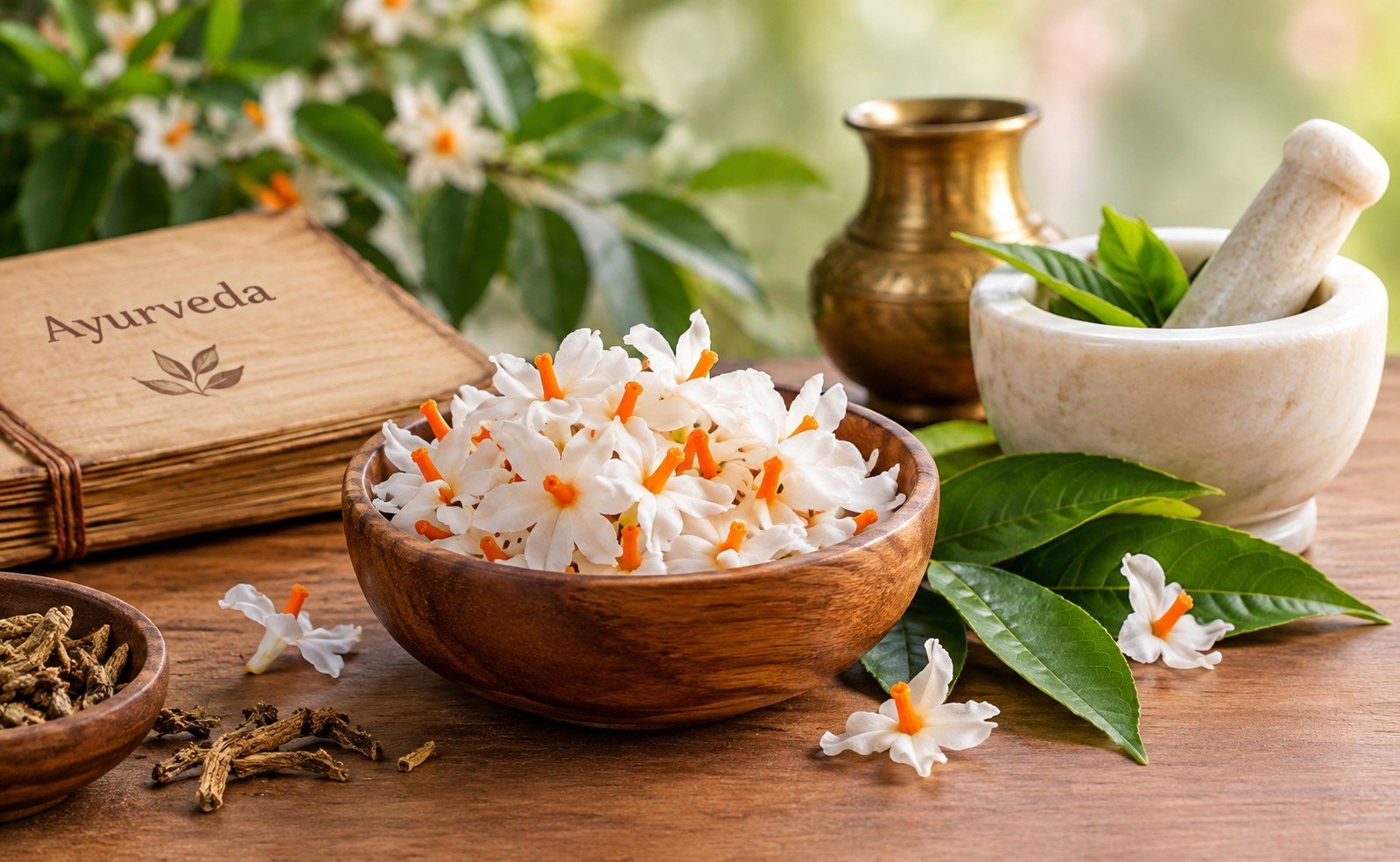
Parijat Pushp, also known as Harshringar, Harsingar, or Night-Flowering Jasmine, is a fragrant white flower with orange stems that blooms mainly at night. In Indian tradition, Parijat is highly respected for its spiritual connection as well as its traditional medicinal importance.
In Ayurveda and traditional Indian medicine, different parts of the Parijat plant, including its leaves, flowers, bark, and seeds, have been used in traditional preparations. The flowers are particularly valued for their fragrance and cooling nature.
But what are the Ayurvedic benefits of Parijat Pushp? How has Harshringar traditionally been used, and is it safe to consume?
Let’s explore the traditional uses and benefits of Parijat flowers in detail.
What Is Parijat Pushp?
Parijat is commonly identified as Nyctanthes arbor-tristis, a small flowering tree belonging to the Oleaceae family.
The plant is known by several names:
- Parijat
- Harshringar
- Harsingar
- Night-Flowering Jasmine
- Shiuli
- Shefali
Its small white flowers have a distinctive orange or reddish-orange center. The flowers usually open during the night and fall naturally in the early morning.
Because of this unusual flowering pattern, Parijat has an important place in Hindu culture and is associated with several religious stories and traditions.
Parijat Pushp in Ayurveda
In traditional Ayurvedic practice, Parijat is considered an important medicinal plant. However, it is important to understand that Ayurvedic preparations may use different parts of the plant for different purposes.
The leaves and bark are more commonly discussed in traditional medicinal preparations, while the flowers are valued for their traditional properties and uses.
Traditional Ayurvedic and folk practices have associated Parijat with supporting the body’s natural response to inflammation, fever, digestive discomfort, and certain respiratory complaints.
Scientific research on Nyctanthes arbor-tristis has also investigated compounds found in the plant for antioxidant and anti-inflammatory activity. However, much of the available evidence comes from laboratory or preliminary studies rather than large human clinical trials.
7 Traditional Ayurvedic Benefits of Parijat Pushp
1. Traditionally Used for Fever Support
Parijat is traditionally associated with preparations used during fever and febrile conditions.
Various parts of the plant, particularly the leaves and bark, have been used traditionally in herbal preparations. The plant should not, however, be considered a replacement for medical treatment when someone has a high or persistent fever.
2. May Have Antioxidant Properties
Parijat contains naturally occurring plant compounds that have been investigated for antioxidant activity.
Antioxidants help protect cells from oxidative stress. Preliminary laboratory research on Nyctanthes arbor-tristis has shown antioxidant potential, although more human research is needed to establish its health benefits.
3. Traditionally Associated With Anti-Inflammatory Activity
Traditional medicine has used Parijat preparations for conditions associated with inflammation and discomfort.
Research has also investigated the plant’s anti-inflammatory properties. However, these findings should not be interpreted as proof that simply eating Parijat flowers can treat inflammatory diseases.
4. Traditional Support for Joint and Muscle Discomfort
Parijat has a long history of traditional use for aches and discomfort affecting the joints and muscles.
Some traditional preparations use the leaves or other parts of the plant rather than the flowers alone. Therefore, it is more accurate to describe Parijat as a traditional herbal remedy for joint discomfort rather than claiming that Parijat flowers cure arthritis.
5. Traditionally Used for Respiratory Complaints
In traditional Indian medicine, Parijat preparations have been used for certain respiratory complaints, including cough.
Its traditional use in this area has contributed to the plant’s popularity in herbal medicine. Nevertheless, persistent cough, breathing difficulty, or other serious respiratory symptoms require proper medical evaluation.
6. May Support Digestive Health Traditionally
Parijat has also been used traditionally for certain digestive complaints.
Traditional herbal preparations made from the plant have been associated with supporting digestion and normal gastrointestinal function. However, there is limited clinical evidence specifically demonstrating that Parijat flowers improve digestion in humans.
7. Traditionally Valued for Its Natural Plant Compounds
Apart from its religious and cultural importance, Parijat contains several naturally occurring phytochemicals.
Researchers have studied different parts of Nyctanthes arbor-tristis for compounds that may have antioxidant, anti-inflammatory, antimicrobial, and other biological activities.
These findings are interesting from a research perspective, but further human studies are needed before specific medical claims can be made.
How Is Parijat Traditionally Used?
Traditional practices may use different parts of the Parijat plant in different ways.
Common traditional forms include:
- Herbal decoctions prepared from plant parts
- Traditional leaf preparations
- Powdered plant material
- Herbal formulations containing Parijat
- Flowers used in religious rituals and offerings
The exact preparation and dosage can vary considerably.
Do not assume that a traditional preparation is automatically safe to consume. If you are considering Parijat as an herbal remedy, particularly in concentrated form, it is better to consult a qualified Ayurvedic practitioner or healthcare professional.
Can You Eat Parijat Flowers?
Parijat flowers are primarily known as religious and ornamental flowers rather than as a common food.
Although traditional practices may use different parts of the plant medicinally, there is not enough reliable clinical evidence to recommend eating Parijat flowers regularly for health benefits.
It is therefore better not to promote raw Parijat flowers as a daily health supplement.
Parijat Flower vs Parijat Leaves in Ayurveda
One important distinction is often missed when discussing Parijat benefits.
Parijat flowers and Parijat leaves are not interchangeable.
Traditional medicinal preparations have frequently focused on the leaves, bark, and other parts of the plant, depending on the intended use. Therefore, research or traditional claims about the medicinal properties of the Parijat plant should not automatically be presented as proven benefits of the flowers.
This distinction makes a Parijat article more accurate and avoids exaggerating the health benefits of the flower.
Are There Any Side Effects or Precautions?
There is limited clinical information about the safety of consuming Parijat flowers as a food or supplement.
For this reason:
- Avoid consuming large quantities of the flowers.
- Do not use concentrated herbal preparations without professional guidance.
- Pregnant or breastfeeding women should consult a healthcare professional before using medicinal preparations.
- People taking regular medicines should seek professional advice before using Parijat medicinally.
- Do not replace prescribed treatment with Parijat or another herbal remedy.
- Stop using a preparation if you experience an unusual reaction.
The safety of a plant can also depend on its preparation, concentration, quantity, and the individual using it.
Parijat Pushp and Hindu Spiritual Tradition
Parijat is not valued only for its traditional medicinal associations. It also has deep spiritual significance in Hindu tradition.
The fragrant flowers are commonly offered during puja, and the plant is associated with stories involving Lord Krishna and the heavenly Parijata tree.
Because the flowers naturally fall to the ground after blooming, devotees can often collect fallen flowers for religious use without plucking them directly from the tree.
This combination of spiritual symbolism, natural beauty, fragrance, and traditional plant knowledge makes Parijat one of India’s most culturally significant flowers.
What Does Modern Research Say About Parijat?
Modern researchers have studied Nyctanthes arbor-tristis for several biological properties.
Laboratory and preliminary studies have investigated its:
- Antioxidant activity
- Anti-inflammatory activity
- Antimicrobial properties
- Potential effects on fever-related pathways
- Various phytochemical compounds
However, laboratory findings are not the same as proven health benefits in humans.
More well-designed clinical studies are needed to determine the effectiveness, appropriate dosage, and long-term safety of specific Parijat preparations.
Frequently Asked Questions About Parijat Pushp
What is Parijat Pushp?
Parijat Pushp is the flower of Nyctanthes arbor-tristis, commonly known as Harshringar, Harsingar, or Night-Flowering Jasmine. It is traditionally valued in India for both spiritual and medicinal purposes.
What are the Ayurvedic benefits of Parijat flowers?
Traditionally, Parijat is associated with fever support, inflammation, joint discomfort, respiratory complaints, digestive support, and antioxidant activity. However, scientific evidence for specific benefits of the flowers in humans remains limited.
Is Parijat flower good for health?
Parijat has a long history of traditional use, and research has identified potentially useful plant compounds. However, there is not enough clinical evidence to say that eating Parijat flowers provides specific health benefits.
Can we eat Parijat flowers every day?
There is insufficient evidence to recommend eating Parijat flowers every day. If you want to use Parijat medicinally, consult a qualified Ayurvedic practitioner or healthcare professional.
Which part of Parijat is used in Ayurveda?
Traditional medicinal practices have used several parts of the Parijat plant, including its leaves, bark, seeds, and flowers. The leaves and other plant parts are commonly discussed in traditional medicinal preparations.
Is Parijat the same as Night-Flowering Jasmine?
Yes. Parijat, Harshringar, and Harsingar are common Indian names associated with Nyctanthes arbor-tristis, which is commonly called Night-Flowering Jasmine in English.
Final Thoughts
Parijat Pushp is much more than a beautiful fragrant flower. It holds a special place in Hindu traditions and has also been associated with traditional Indian herbal medicine for generations.
From traditional fever and inflammation-related preparations to its potential antioxidant properties, Parijat continues to attract interest from both traditional medicine and modern researchers.
At the same time, it is important to separate traditional Ayurvedic use from scientifically proven medical benefits. Current research is promising in some areas, but stronger human studies are still needed.
For spiritual use, Parijat remains a beautiful and meaningful flower for puja and devotional practices. For medicinal use, it is best to seek guidance from a qualified professional rather than self-treating with concentrated preparations.