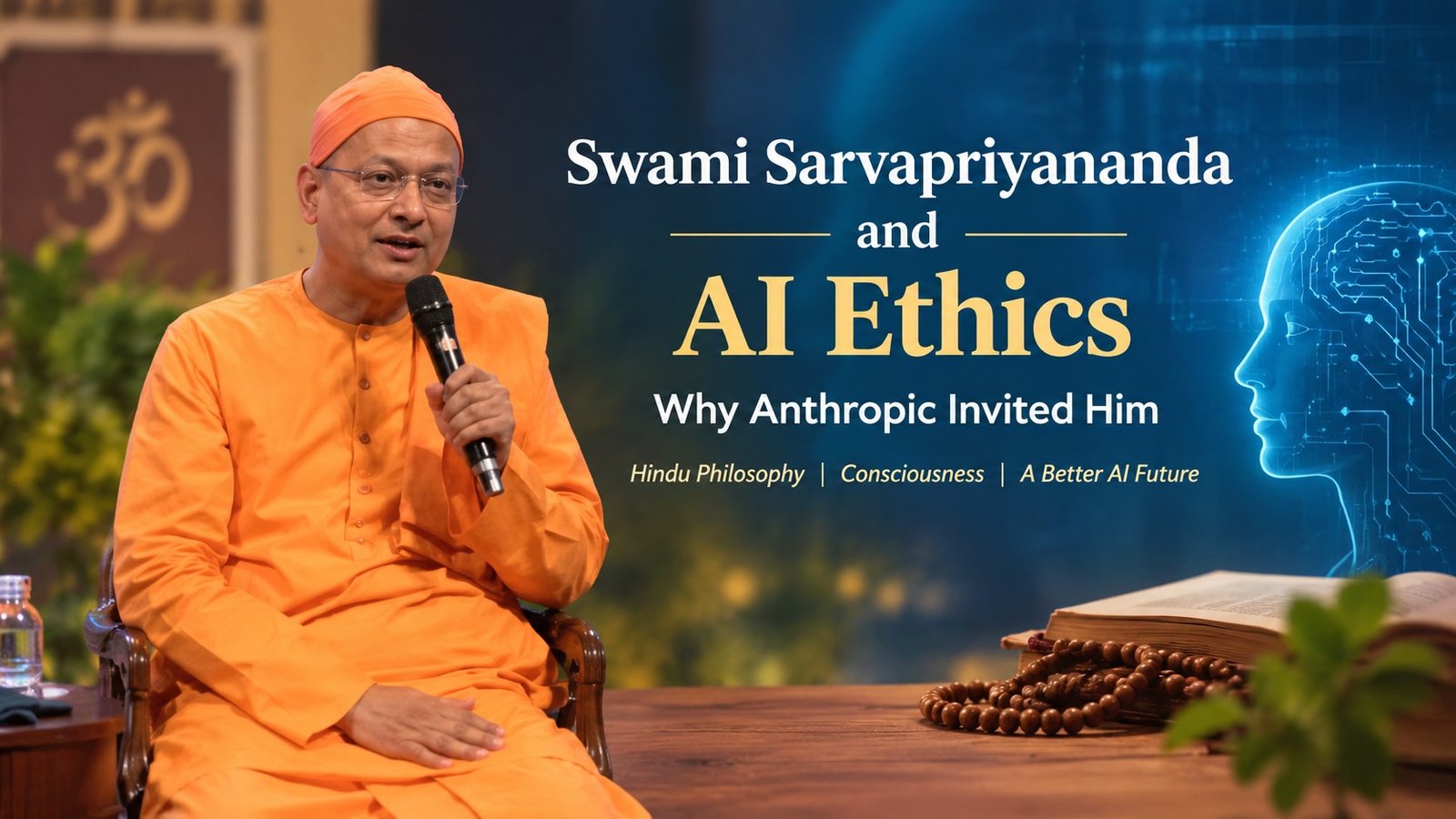
Can ancient Hindu philosophy help shape the future of artificial intelligence? This question has attracted attention after Swami Sarvapriyananda, a respected Hindu monk and Vedanta teacher, spoke about his visit to Anthropic, the company behind the Claude family of AI models.
According to his account, Anthropic invited him to its headquarters in San Francisco for discussions related to artificial intelligence, ethics and morality. The story gained attention in October 2026 after videos of his earlier public talk began circulating on social media.
The reported meeting has raised an interesting question: why would a modern technology company seek insights from a Hindu monk when developing artificial intelligence?
The answer involves more than technology. It touches on the nature of consciousness, the meaning of right and wrong, and the role of human values in a world increasingly influenced by AI.
Who Is Swami Sarvapriyananda?
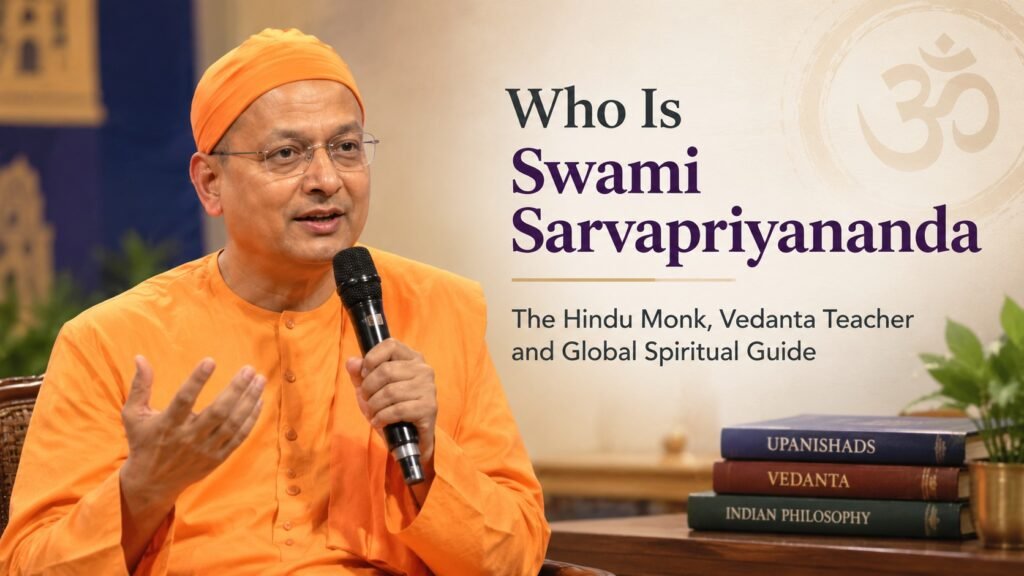
Swami Sarvapriyananda is a Hindu monk belonging to the Ramakrishna Order and the head of the Vedanta Society of New York. He is widely known for explaining Indian philosophy, particularly Advaita Vedanta, to audiences in India and abroad.
His lectures explore subjects such as the Upanishads, the nature of the self, consciousness and the relationship between individual identity and ultimate reality.
Through his public talks and online lectures, he has introduced many people to traditional Hindu philosophical ideas in a way that connects with modern questions about life, the mind and existence.
His work is especially relevant to discussions about consciousness because Advaita Vedanta examines a fundamental question: What is the true nature of the self?
This question has also become important in modern discussions about artificial intelligence.
Why Did Anthropic Invite Swami Sarvapriyananda?
Anthropic develops Claude, a family of artificial intelligence models used for tasks such as answering questions, writing, coding and reasoning.
As AI systems become more capable, developers face an important challenge. It is not enough for an AI system to produce an answer that sounds intelligent. It must also respond responsibly, recognise risks and handle situations involving conflicting values.
According to reports based on Swami Sarvapriyananda’s account, Anthropic initially approached him for an online conversation before inviting him to its San Francisco headquarters.
He later described the visit during a talk at Unity of Dallas in June 2026. He said the discussions involved AI ethics and the training of Claude.
He also described meeting religious thinkers from different traditions, along with counsellors and mental health professionals.
Much of the meeting reportedly remained private because participants were asked to sign a non-disclosure agreement. Therefore, the exact contribution of each participant and the specific conclusions reached during the discussions have not been publicly established.
Nevertheless, the reported invitation highlights a broader effort to examine AI behaviour through perspectives that extend beyond computer science.
What Is AI Ethics, and Why Does It Matter?
AI ethics refers to the principles and values that guide how artificial intelligence is developed and used.
An AI system may be able to generate a convincing answer, but that does not automatically mean the answer is fair, safe or morally appropriate.
For example, imagine someone asks an AI system for advice during a personal crisis. The system must consider not only what information to provide but also whether its response could cause harm.
Similarly, an AI model may face questions involving privacy, discrimination, honesty, responsibility or conflicting human interests.
Developers use safety guidelines, training methods and behavioural principles to help models handle these situations. Anthropic has also published a constitution for Claude that describes the values and principles intended to guide its behaviour.
However, difficult ethical questions do not always have simple answers. This is one reason why philosophical traditions may offer useful perspectives.
Religious and philosophical thinkers have spent centuries examining questions about human behaviour, responsibility, suffering, self-control and the difference between beneficial and harmful actions.
Their ideas can contribute to a wider discussion about how AI should behave, even though technology companies must still test and evaluate their systems carefully.
How Can Hindu Philosophy Help Us Understand AI?
Hindu philosophy contains several schools of thought, each with its own understanding of reality, consciousness and ethical living. One tradition particularly relevant to this discussion is Advaita Vedanta.
1. Understanding the Difference Between Intelligence and Consciousness
One of the central questions in Advaita Vedanta concerns the nature of consciousness.
Modern AI systems can process information, recognise patterns, generate language and solve certain complex problems. However, these abilities do not establish that a system has subjective experience or is conscious in the same way humans are.
Advaita Vedanta approaches consciousness as a fundamental philosophical question rather than simply a measure of intellectual ability.
This distinction is important because a machine that speaks fluently about emotions or spirituality should not automatically be assumed to experience those things.
The discussion encourages us to examine what we mean when we use words such as awareness, intelligence, mind and consciousness.
2. The Importance of Ethical Behaviour
Hindu philosophical traditions discuss concepts such as dharma, which can refer to duty, responsibility, righteous conduct and living in accordance with ethical principles.
The practical meaning of dharma depends on the situation and the philosophical tradition being discussed. It is not simply a single rule that answers every moral question.
For AI developers, the broader lesson is that responsible behaviour requires more than the ability to follow instructions.
An AI system may need to consider the possible consequences of its answers, respect human dignity and avoid helping people cause harm.
Although dharma cannot simply be converted into a technical formula, it offers a valuable starting point for discussing responsible decision-making.
3. Looking Beyond Self-Interest
Advaita Vedanta explores the relationship between the individual self and ultimate reality. Its teachings can encourage reflection on the limits of ego-centred thinking and the importance of understanding our connection with others.
In practical ethical discussions, this perspective can prompt questions about how decisions affect people beyond the immediate individual making them.
For example, an AI system used by a business should not be evaluated only by how much money it saves. Its effects on employees, customers and society also matter.
This does not mean an AI model can automatically understand selflessness or spiritual unity. Rather, these philosophical ideas can help people discuss the values that should influence the design and use of technology.
Can Artificial Intelligence Understand Right and Wrong?
This is one of the most important questions raised by the reported meeting.
AI models can be trained to recognise ethical guidelines, identify harmful requests and provide answers that follow particular principles. They can also explain different moral arguments.
However, following ethical instructions is not necessarily the same as possessing human moral understanding.
A model may produce an appropriate answer without having personal experiences, emotions or an inner sense of responsibility.
There is also an important difference between behaving as if something is understood and establishing that genuine understanding or consciousness exists.
Scientists and philosophers continue to debate the nature of consciousness, and there is no established basis for concluding that today’s language models possess human-like subjective experience simply because they communicate convincingly.
The reported discussions involving Anthropic and religious thinkers bring these questions into focus. They show why AI development increasingly involves questions about values, human behaviour and the limits of machine intelligence.
Why Is This News Important for Hindu Spirituality?
The story is significant because it shows how ideas from Indian philosophy can enter conversations about modern technology.
Hindu spiritual traditions have long explored questions about the self, awareness, knowledge, duty and the purpose of human life. These subjects are now being discussed alongside developments in artificial intelligence.
For readers interested in Hindu spirituality, the news provides an opportunity to explore Vedanta beyond familiar topics such as meditation, prayer and religious rituals.
It also demonstrates that spiritual philosophy can be relevant to contemporary questions without needing to be presented as a replacement for science.
Technology researchers can study the capabilities and limitations of AI through experiments and technical evaluation. Philosophical traditions can help people examine the assumptions and values behind how these systems should be used.
Both perspectives can contribute to a thoughtful discussion, provided their different roles are understood.
Did Anthropic Ask Swami Sarvapriyananda to Join the Company?
According to reports, Swami Sarvapriyananda clarified that the initial approach was for an online conversation, not a job offer. He was subsequently invited to visit Anthropic’s San Francisco headquarters.
His account describes discussions related to AI ethics and Claude’s training. However, the full details of the private meetings have not been publicly disclosed.
It would therefore be inaccurate to claim that he was hired by Anthropic, became an AI developer or single-handedly designed Claude’s moral framework.
The available reporting instead points to consultation and discussion involving people with different religious, philosophical and professional backgrounds.
Conclusion: Ancient Wisdom Meets Modern Technology
The reported meeting between Swami Sarvapriyananda and Anthropic highlights an unusual connection between Hindu philosophy and artificial intelligence.
As AI systems become more capable, questions about their behaviour, safety and ethical boundaries are becoming increasingly important. These challenges cannot always be addressed by technical performance alone.
Advaita Vedanta offers a philosophical way to explore consciousness and the nature of the self, while broader Hindu teachings provide perspectives on duty, responsibility and ethical conduct.
These ideas do not prove that AI can become conscious, nor do they provide automatic solutions to every ethical dilemma. They can, however, help people ask better questions about the technology they are creating.
Perhaps the most important lesson is that technological progress should be accompanied by serious reflection on human values.
Ancient spiritual traditions and modern scientific research come from different approaches to understanding the world. When their differences are respected, conversations between them can open new ways of thinking about intelligence, consciousness and the future of humanity.
Frequently Asked Questions (FAQs)
1. Who is Swami Sarvapriyananda?
Swami Sarvapriyananda is a Hindu monk of the Ramakrishna Order and the head of the Vedanta Society of New York. He is known for teaching Advaita Vedanta and explaining Indian philosophy to international audiences.
2. Why did Anthropic invite Swami Sarvapriyananda?
According to his account and media reports, Anthropic invited him to discuss AI ethics, morality and the training of its Claude models. The full details of the private discussions have not been disclosed.
3. What is Anthropic’s Claude AI?
Claude is a family of artificial intelligence models developed by Anthropic. These models can assist with writing, coding, research, analysis and other language-based tasks.
4. What is the connection between Vedanta and artificial intelligence?
Vedanta explores subjects such as consciousness, the self and the nature of reality. These subjects are relevant to philosophical debates about whether artificial intelligence can ever possess consciousness and how intelligent systems should behave.
5. Does artificial intelligence have consciousness?
There is no established evidence that today’s language models possess human-like subjective experience. Their ability to generate intelligent-sounding responses does not, by itself, prove consciousness.
6. What is the meaning of dharma in Hindu philosophy?
Dharma has several related meanings, including duty, responsibility, righteous conduct and ethical living. Its interpretation varies according to context and philosophical tradition.
7. Did Swami Sarvapriyananda develop Claude AI?
There is no verified evidence that he developed Claude or designed its complete ethical framework. Reports describe his participation in discussions about AI ethics and training.
8. Why is this story important for India?
The story brings Indian philosophical traditions into an international conversation about artificial intelligence. It also encourages readers to explore how concepts from Hindu philosophy can contribute to discussions about consciousness and ethical responsibility.