
The phrase “Patient Zero” has become widely recognized in modern language, especially when people discuss disease outbreaks, investigations and the beginning of a chain of events. But what exactly does Patient Zero mean, and can this idea be connected to Hindu spirituality and the concept of karma?
The answer requires an important distinction.
Patient Zero is not a traditional Hindu religious concept. In public health and popular media, the phrase is generally used to describe a person associated with the beginning or early spread of an outbreak. In Hindu philosophy, however, there is a different and much older idea that can be discussed alongside this concept: karma, the relationship between action and consequence.
This comparison can give us an interesting way to think about how one action may become the beginning of a much larger chain of events.
What Does Patient Zero Mean?

“Patient Zero” is a popular term used to describe an individual believed to be connected to the beginning of an outbreak or transmission chain.
However, the term can be misleading when used as if it always identifies the very first person who became infected. In real epidemiological investigations, identifying the exact first infection may be difficult or impossible.
The term also became famous because of historical discussions surrounding the early HIV epidemic in the United States. One well-known example involved the misinterpretation of the designation “Patient O,” which referred to a person “out of California,” as the number zero. The resulting “Patient Zero” story became part of popular culture.
Therefore, Patient Zero should not automatically be understood as “the first person who caused an outbreak.”
It is better to think of it as a popular expression associated with tracing the beginning or early stages of a transmission chain.
Is Patient Zero a Hindu Concept?
No.
There is no traditional Hindu doctrine known as “Patient Zero.”
Hindu philosophy has its own concepts concerning action, consequence, dharma, rebirth and liberation. Among these, karma is particularly relevant when discussing cause and effect.
The Sanskrit word karma is related to action or deed. In Hindu philosophical discussions, karma can refer to the consequences associated with actions and is closely connected with ideas of moral causation and, in many traditions, rebirth.
So, while Patient Zero and karma come from completely different contexts, we can use the idea of a “starting point” as a simple modern analogy for thinking about how actions can initiate consequences.
Patient Zero and the Idea of a First Cause
Imagine a single event that sets off a chain:
One action → another event → another consequence → a larger chain of effects
In an infectious disease investigation, researchers may try to trace how an infection moved through a population.
In everyday life, we can similarly look at our actions and ask:
- What did this action create?
- How did my words affect another person?
- Did one decision create a habit?
- Did one small action eventually produce a much larger consequence?
This is where the comparison with karma becomes interesting.
Hindu philosophical traditions discuss karma in terms of causation in the moral sphere: actions are understood as having consequences, although different Hindu schools explain karma, intention, agency and liberation in different ways.
What Is Karma in Hindu Philosophy?
Karma is often translated simply as action, deed or work, but its philosophical meaning is deeper than the popular idea that “whatever happens to you is karma.”
In Hindu thought, karma is connected with the relationship between actions and their consequences. Oxford’s discussion of classical Hindu thought describes karma in terms of extending principles of causation into human conduct.
Encyclopaedia Britannica similarly describes karma as a causal principle in Indian philosophy in which actions influence future circumstances and, in many traditions, the process of rebirth.
This means karma should not simply be understood as:
“Something bad happened, so that person must have done something bad.”
That kind of conclusion oversimplifies a complex philosophical idea.
Karma is better understood as a framework for considering action, intention, consequence and responsibility.
Is Karma the Same as Fate?
Not exactly.
Karma is sometimes mistakenly treated as another word for fate or destiny. However, Hindu philosophical discussions have more nuanced approaches to the relationship between past actions, present circumstances and human agency.
Modern Hindu thought, for example, includes interpretations that emphasize the role of free will and reject reducing karma to simple fatalism.
This gives the idea of karma an important practical dimension.
Your past actions may be part of the circumstances you experience, but your present actions also matter.
In simple terms:
Past actions can influence your circumstances, while present actions help shape what comes next.
The Spiritual Lesson: Every Action Can Become a Starting Point
This is perhaps the most useful way to connect the modern idea of Patient Zero with spiritual reflection.
A person may not realize that a small action is beginning a much larger chain.
For example:
One angry word may lead to an argument.
An argument may create resentment.
Resentment may damage a relationship.
Likewise, one positive action can begin another chain:
A kind word may give someone hope.
That person may become more compassionate toward someone else.
That compassion may continue to another person.
In this sense, every action can become the starting point of consequences.
This is not a literal Hindu interpretation of “Patient Zero.” It is simply a modern analogy that can help us think about karma and personal responsibility.
Can Naam Jaap Help Us Become More Conscious of Our Actions?

One reason spiritual practices such as naam jaap are valued by many devotees is that they encourage regular attention and remembrance of the Divine.
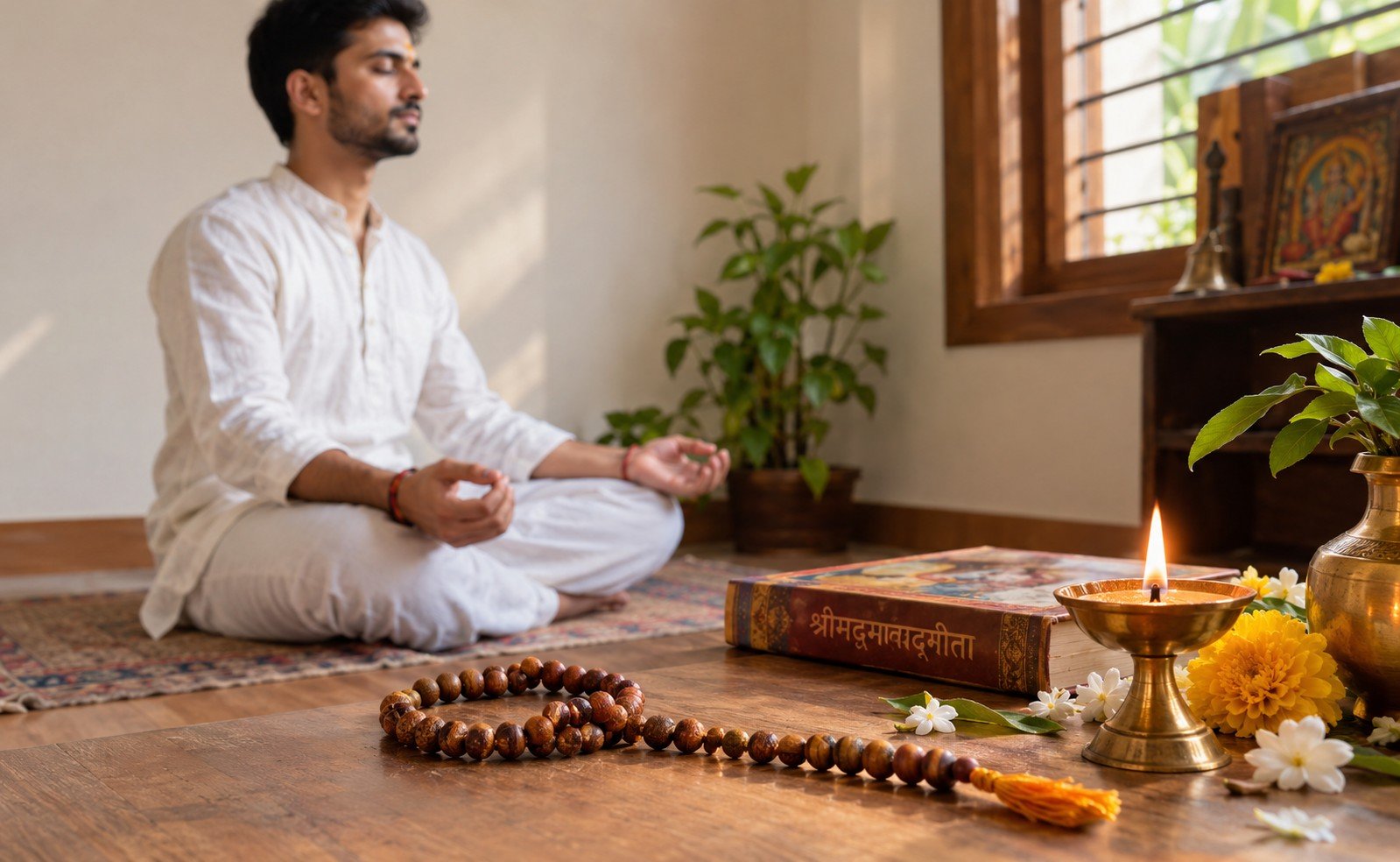
Naam jaap means repeating or chanting a sacred name or mantra with devotion and concentration.
For many practitioners, regular chanting becomes a way to slow down the mind and create a more conscious daily routine.
The broader spiritual principle is simple:
Before changing our actions, we often need to become more aware of our thoughts and intentions.
A regular practice of prayer, mantra chanting or meditation can become part of that process.
Karma yoga, another important concept in Hindu thought, also emphasizes performing one’s actions in an appropriate spirit rather than being driven purely by self-centered desire.
What Does This Teach Us About Negative Karma?
It is easy to interpret karma as a system of punishment.
However, Hindu philosophical discussions are more complicated than the popular phrase “what goes around comes around.”
Karma is connected with causation, ethical action and, in many Hindu traditions, the cycle of rebirth and the pursuit of moksha.
Instead of constantly asking:
“What karma did this person do to deserve this?”
a more constructive spiritual question is:
“What actions am I creating through my thoughts, words and behavior today?”
That shifts the focus from judging others to examining ourselves.
Three Simple Ways to Apply the Idea of Karma in Daily Life
1. Watch Your Words
Words can create consequences long after they are spoken.
Before speaking, ask:
Is it true? Is it necessary? Can I say it with kindness?
Practicing thoughtful speech can become a form of everyday spiritual discipline.
2. Pay Attention to Your Intentions
Two people can perform a similar action with completely different intentions.
Hindu philosophical traditions have differing views on how intention, action and consequence interact, so karma should not be reduced to a simplistic formula. Still, examining one’s motivation is an important part of ethical and spiritual reflection.
Ask yourself:
Why am I doing this?
3. Create Positive Daily Habits
Small spiritual practices can become powerful habits when performed consistently.
You might begin the day with:
- A few minutes of naam jaap
- A short prayer
- Meditation
- Reading a verse from the Bhagavad Gita
- Offering gratitude
- Performing an act of seva
The objective is not simply to “collect good karma,” but to cultivate greater awareness and devotion in everyday life.
Patient Zero, Karma and the Chain of Consequences
The biggest difference between the two ideas is important to remember.
Patient Zero belongs to modern language surrounding disease outbreaks and transmission.
Karma belongs to Indian philosophical and religious traditions and concerns action and consequence.
They are not the same concept.
But as a metaphor, the idea of tracing a chain back to its beginning can encourage an interesting spiritual question:
Where did my current pattern begin?
Perhaps it began with one decision.
One thought.
One habit.
One reaction.
And if an unwanted pattern can begin with one action, a positive transformation can also begin with one action.
That action could be a sincere prayer, an act of kindness, a commitment to seva, or simply a few peaceful minutes of naam jaap each day.
Can One Positive Action Change Your Life?
Spiritual transformation does not always begin with something dramatic.
Sometimes it begins quietly.
You decide to wake up a little earlier.
You spend five minutes chanting a mantra.
You stop responding immediately when you are angry.
You help someone without expecting anything in return.
You become more conscious of what you say.
Over time, these small actions can become habits, and habits can influence the way we live.
This is one useful way to reflect on karma: our actions matter, and our present choices are still meaningful.
A Simple Naam Jaap Practice for Daily Life
If you want to incorporate naam jaap into your routine, you do not necessarily need a complicated ritual.
Choose a peaceful place and sit comfortably.
Select a divine name or mantra that is meaningful to your tradition and repeat it with attention.
You can use a japa mala to keep track of repetitions or a simple jaap counter if you prefer a digital or finger-counting method.
Start with a manageable number of repetitions and focus on consistency rather than speed.
The purpose is to bring the mind back to the sacred name whenever it wanders.
Over time, this can become a regular moment of prayer, remembrance and self-reflection.
Final Thoughts
The phrase “Patient Zero” belongs to the language of modern epidemiology and popular culture. It should not be presented as an ancient Hindu spiritual concept.
However, the idea of tracing a chain back to its beginning can provide a useful modern metaphor for thinking about karma, action and consequence.
Hindu philosophical traditions have long explored the relationship between action and its results. Karma is not simply about blaming someone for their circumstances or predicting that every event has an obvious past cause. It is a deeper philosophical subject involving action, consequence, ethical responsibility, agency and, in many traditions, rebirth and liberation.
Perhaps the most practical lesson is this:
Every day gives us another opportunity to choose the actions that begin our next chain of consequences.
A kind word.
A sincere prayer.
A moment of seva.
A mindful decision.
Or a few minutes of naam jaap.
Sometimes, meaningful change begins with something very small.
Frequently Asked Questions
What does Patient Zero mean?
Patient Zero is a popular term associated with the person believed to be connected to the beginning or early spread of an infectious outbreak. It does not always mean the scientifically confirmed first person infected.
Is Patient Zero a Hindu concept?
No. Patient Zero is a modern public-health and popular-media term. It is not a traditional concept from Hindu scriptures or Hindu philosophy.
What does karma mean in Hinduism?
Karma is related to action or deed and, in Hindu philosophical traditions, refers to the relationship between actions and their consequences. It is also connected with rebirth and liberation in many Hindu traditions.
Is karma the same as fate?
No. Karma and fate are often treated as synonyms in popular culture, but Hindu philosophical traditions contain more nuanced views about causation, present action and human agency.
How is Patient Zero related to karma?
They are not literally related. Patient Zero is a modern term associated with tracing disease transmission, while karma is a Hindu philosophical concept concerning action and consequence. Patient Zero can only be used as a modern metaphor for thinking about how one event or action may begin a larger chain of consequences.
Can naam jaap be part of a spiritual routine?
Yes. Naam jaap, prayer and mantra repetition are practiced by many devotees as forms of remembrance and spiritual discipline. A person can incorporate chanting into a regular daily routine according to their tradition and personal practice.