Have you ever wondered why people chant mantras repeatedly during meditation, prayer or yoga?
From ancient Hindu traditions to modern meditation rooms in the US, UK and around the world, mantra chanting has become a practice that connects spirituality, concentration and mindfulness.
For a devotee, chanting a mantra can be an act of prayer and remembrance of the Divine. For someone approaching it from a meditation or wellness perspective, repeating a word or sound can provide a simple point of focus for the mind.
Modern research has also started examining mantra-based meditation. Some studies suggest that these practices may help reduce perceived stress and anxiety, although the scientific evidence is still developing and should not be interpreted as proof that chanting can treat a medical condition.
So, why do people chant mantras?
The answer involves both spirituality and the way repetitive practices can influence attention and mental habits.
What Is a Mantra?
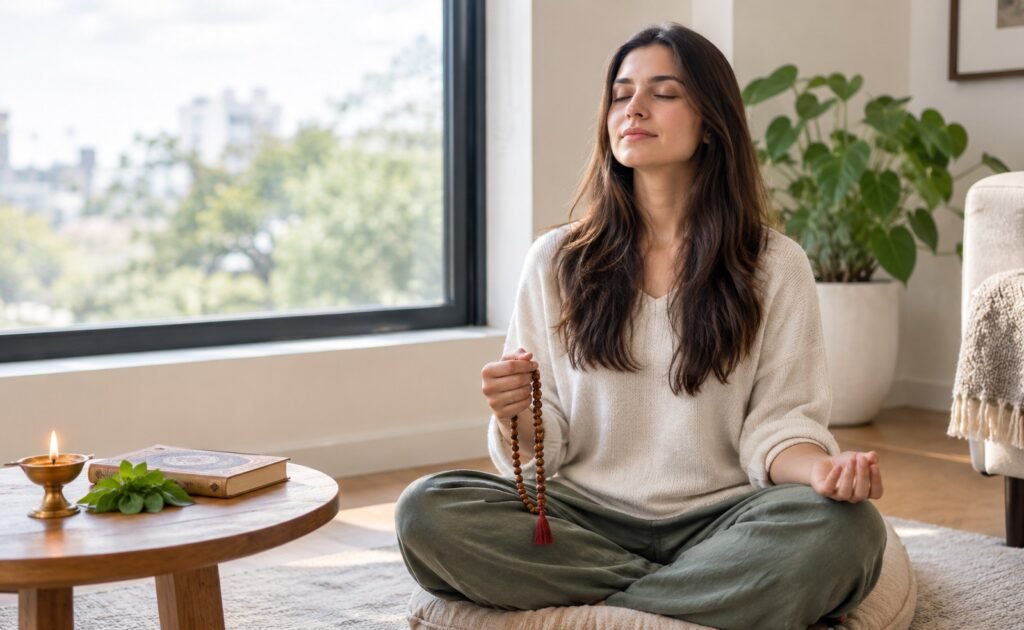
The word mantra comes from the Sanskrit tradition and generally refers to a sacred sound, word or phrase used in spiritual practice.
A mantra may be chanted:
- Aloud
- Softly
- Silently in the mind
- During meditation
- During prayer
- While using a japa mala
- During personal or group devotional practice
Different spiritual traditions use different mantras.
In Hindu practice, mantras can be associated with particular deities, spiritual teachings or forms of devotion. Some practitioners repeat a divine name, while others use traditional Sanskrit mantras.
The purpose can therefore vary from person to person.
For one person, mantra chanting may be primarily devotional.
For another, it may be a meditation technique.
For another, it may be a way to create a peaceful daily routine.
Why Do People Chant Mantras?
There isn’t just one reason.
People chant mantras for spiritual, devotional, meditative and personal reasons.
1. To Focus the Mind
One of the simplest explanations for mantra meditation is that repetition gives the mind something specific to focus on.
Instead of continuously following every thought that appears, the practitioner repeatedly returns attention to the mantra.
For example:
Mantra → distraction → notice distraction → return to mantra
This cycle can continue throughout meditation.
The goal isn’t necessarily to stop every thought.
Instead, the practice can involve repeatedly bringing attention back to one chosen point.
Research on mantra-based meditation describes mantra repetition as a form of focused-attention practice in which the repeated sound, word or phrase can serve as an object of attention.
2. For Spiritual Connection
For Hindu devotees, mantra chanting is not simply a relaxation technique.
It can be an expression of bhakti, devotion and remembrance of the Divine.
Naam jaap, for example, involves repeating a divine name with devotion.
A person may chant:
- Hare Krishna
- Ram
- Om Namah Shivaya
- Om Namo Bhagavate Vasudevaya
- Other mantras according to their spiritual tradition
The meaning and importance of a mantra can depend on the tradition in which it is practiced.
For a devotee, the practice can become a regular reminder to turn the mind toward God.
3. To Create a Daily Meditation Routine
One of the practical challenges of meditation is knowing what to focus on.
A mantra can provide a simple structure.
Instead of wondering:
“What should I think about while meditating?”
the practitioner has a clear practice:
Repeat → listen → notice → return → repeat.
This can make meditation easier to approach, particularly for beginners.
Mantra-based meditation has also been studied as a distinct form of meditation involving repeated words, phrases or syllables.
4. To Calm a Busy Mind
Modern life can involve constant notifications, work demands, social media and information.
For some people, sitting quietly and repeating a mantra provides a break from this constant stimulation.
The practice doesn’t guarantee that the mind will immediately become calm.
Thoughts can continue to appear.
But the repeated mantra gives the practitioner something to return to.
A 2022 systematic review and meta-analysis of randomized controlled trials found that mantra-based meditation was associated with small-to-moderate reductions in anxiety and stress compared with control conditions. However, the authors also highlighted limitations including risk of bias and limited long-term follow-up.
What Does Science Say About Mantra Meditation?
This is where it is important to separate spiritual belief from scientific evidence.
Science can study measurable outcomes such as:
- Self-reported stress
- Anxiety
- Mood
- Attention
- Sleep
- Physiological responses
- Brain activity
Science cannot establish the spiritual meaning of a particular deity or mantra in the same way that a religious tradition understands it.
Research into mantra-based meditation is growing.
A systematic review and meta-analysis published in 2022 examined randomized controlled trials involving mantra-based meditation. The researchers reported significant small-to-moderate effects for reductions in anxiety, depression and stress, along with improvements in mental-health-related quality of life. They also cautioned that the evidence was weakened by methodological limitations and a lack of long-term follow-up.
This means the research is promising but not definitive.
Can Chanting Reduce Stress?
There is some evidence suggesting that mantra-based practices may help with perceived stress.
The 2022 systematic review found a significant effect favoring mantra-based meditation for stress reduction.
Another study involving group chanting examined vocal and silent repetition of the sound “Om.” The researchers reported decreases in cortisol and self-reported anxiety after the session, with vocal chanting showing a greater reduction in self-reported anxiety in that particular study.
However, a single study should not be treated as proof that chanting works the same way for everyone.
Research methods, participants, types of chanting and meditation schedules vary considerably.
Can Mantra Chanting Help With Anxiety?
Research suggests there may be an association between mantra-based meditation and lower anxiety.
The 2022 meta-analysis found a small-to-moderate reduction in anxiety across the studies it examined.
But it is important to use the right language.
It is more accurate to say:
“Research suggests mantra-based meditation may help reduce anxiety symptoms.”
It is not accurate to say:
“Mantras cure anxiety.”
Meditation should not be presented as a replacement for professional medical or mental-health care.
Does Chanting Affect the Brain?
Researchers have also begun investigating what happens in the brain during chanting.
A recent systematic review of neuroimaging studies found that chanting was associated with activity in brain regions involved in attention and emotional regulation. The review also reported findings involving parts of the default mode network and changes in EEG activity, although differences between studies make broad conclusions difficult.
This research provides an interesting scientific perspective on an ancient practice.
However, neuroscience does not establish the spiritual meaning of a mantra.
It can investigate what happens during the practice, while religious traditions address why the practice is spiritually meaningful.
Why Repetition Is Important
Repetition is at the heart of mantra practice.
When a person repeats the same sound or phrase again and again, the practice becomes predictable.
This can make it easier to notice when the mind has wandered.
For example:
“Om Namah Shivaya…”
The mind wanders.
You notice it.
You return to:
“Om Namah Shivaya…”
The mind wanders again.
You return again.
That simple process is itself part of meditation.
You don’t have to become frustrated every time your mind wanders.
The return is the practice.
What Is the Spiritual Meaning of Mantra Chanting?
In Hindu spirituality, mantra chanting can be much more than a concentration exercise.
A mantra may be treated as a sacred sound connected with a deity, spiritual teaching or divine name.
For devotees, chanting can represent:
Remembrance → devotion → surrender → inner discipline
Naam jaap especially emphasizes remembrance of the Divine through repetition of a sacred name.
This is why two people can perform the same outward practice but experience it differently.
One may approach mantra repetition as meditation.
Another may approach it as prayer.
Another may combine both.
Mantra Meditation vs Naam Jaap
These terms are related but shouldn’t always be treated as identical.
Mantra Meditation
Mantra meditation generally involves using a mantra as an object of attention during meditation.
The practitioner may repeat it silently or aloud.
The focus may be on concentration, awareness and mental stillness.
Naam Jaap
Naam jaap specifically emphasizes repetition or remembrance of a divine name.
For a devotee, the intention can be deeply devotional.
The practice may be performed while sitting, walking, praying or engaging in everyday activities.
In many devotional traditions, the spiritual purpose is not simply to relax but to maintain remembrance of God.
Why Do People Use a Japa Mala?
A japa mala is traditionally used to help count repetitions of a mantra.
A typical mala contains a series of beads that allow the practitioner to move from one bead to the next while repeating the chosen mantra.
This provides a physical rhythm to the practice.
Instead of constantly checking a clock or counting mentally:
One bead → one repetition
The mala can therefore make the practice more structured.
For many devotees, the mala itself also carries spiritual significance.
Can You Chant Without a Japa Mala?
Yes.
A mala is not essential for chanting.
You can repeat a mantra:
- While sitting quietly
- During meditation
- While walking
- During prayer
- During a morning routine
- Before going to sleep
- During quiet moments throughout the day
Some people prefer a mala because it helps them maintain a specific number of repetitions.
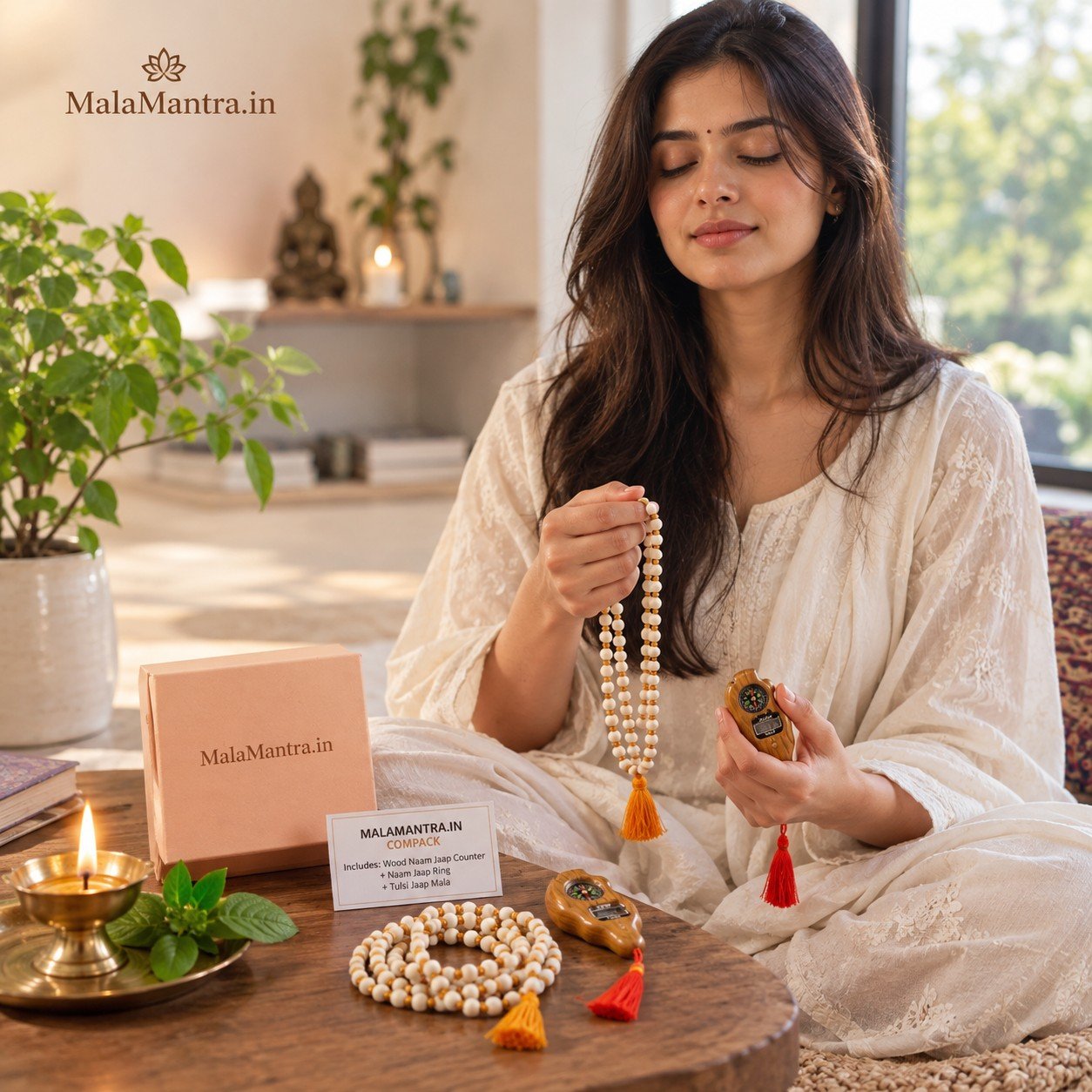
Others prefer a jaap counter, particularly when they want a simple way to count repetitions without carrying a traditional mala.
How Many Times Should You Chant a Mantra?

There is no single number that applies to every mantra or every practitioner.
Traditional practices may prescribe particular counts depending on the mantra and lineage.
For a beginner, however, consistency can be more practical than trying to achieve a very large number immediately.
You could begin with:
5 minutes a day
and gradually develop your practice.
If you prefer counting repetitions, you might choose a manageable number such as 27, 54 or 108 according to your personal practice and tradition.
The important point is to approach the practice with attention rather than treating the number as a competition.
How to Start Mantra Meditation as a Beginner
You can keep your first practice very simple.
Step 1: Choose a Quiet Place
Find a comfortable place where you can sit without interruption.
It doesn’t have to be a temple or elaborate meditation room.
A quiet corner of your home is enough.
Step 2: Choose Your Mantra
Choose a mantra that is meaningful to you and appropriate to your spiritual tradition.
If you already follow a particular Hindu tradition or have received a mantra from a teacher, follow that guidance.
Step 3: Sit Comfortably
You don’t need to force yourself into a complicated yoga posture.
Sit comfortably with your back reasonably upright.
Step 4: Begin Repeating
Repeat your mantra slowly.
You can chant aloud, whisper it or repeat it mentally depending on your practice.
Step 5: Return When Your Mind Wanders
Your mind will probably wander.
That’s normal.
When you notice it, gently return to the mantra.
Step 6: Finish Slowly
After a few minutes, stop chanting and sit quietly for a short time.
Notice how you feel before returning to your normal activities.
What Are the Possible Benefits of Mantra Meditation?
Based on available research and traditional practice, mantra meditation may offer several potential benefits.
Potentially Supports Stress Management
Research has found reductions in stress in some mantra-based meditation studies.
May Support Relaxation
Repetitive chanting can provide a steady focus that some people find calming.
May Help With Attention
Repeatedly returning attention to a mantra can serve as a form of focused-attention practice.
May Support Emotional Regulation
Research into chanting has identified brain activity involving regions associated with attention and emotional regulation, although the evidence remains heterogeneous.
Can Support Spiritual Well-Being
A 2024 systematic review and meta-analysis of mantram repetition found a positive effect on spiritual well-being across seven studies, although the authors noted that additional research is needed to establish the reliability of the findings.
Can Create a Consistent Spiritual Habit
Perhaps one of the most practical benefits is routine.
A few minutes of chanting each day can create a regular period for prayer, reflection and remembrance.
Does the Mantra Have to Be in Sanskrit?
Not necessarily.
Many Hindu mantras are traditionally expressed in Sanskrit, but the broader practice of repeating a sacred name or phrase exists across different spiritual traditions.
For Hindu devotees, the traditional form and pronunciation of a particular mantra may be important.
If you are learning a specific Sanskrit mantra, it is useful to learn its pronunciation and meaning from a reliable traditional source or teacher.
Understanding the meaning can also make the practice more personally meaningful.
Is Chanting a Religious Practice or a Wellness Practice?
It can be either, or both.
A person may chant because they are devoted to a deity.
Another person may approach repetition as a meditation technique.
A third person may combine spiritual devotion with mindfulness.
These different motivations do not necessarily make the practice meaningless.
However, it is important not to erase the religious roots of Hindu mantra practice simply because mantra meditation has become popular in modern wellness culture.
For many Hindus, chanting is fundamentally connected with devotion, remembrance and spiritual practice, not simply stress management.
A Simple 10-Minute Mantra Practice
If you want to begin, try this simple routine:
Minute 1: Sit comfortably and take a few slow breaths.
Minutes 2–3: Begin repeating your chosen mantra slowly.
Minutes 4–8: Continue the repetition. Whenever your mind wanders, gently return to the mantra.
Minute 9: Slow the repetition.
Minute 10: Sit quietly and observe your thoughts and breathing.
You can use a japa mala or jaap counter if you want to count repetitions.
The aim is not to force the mind to become completely empty.
The aim is to practice returning.
Mantra Chanting and Modern Life
One reason mantra meditation may appeal to people in modern Western societies is its simplicity.
You don’t need an expensive studio.
You don’t need complicated equipment.
You don’t necessarily need a large amount of free time.
A quiet space and a few minutes can be enough to begin.
For people interested in Indian spirituality, mantra chanting can also provide a way to explore a traditional practice while developing a consistent meditation routine.
Final Thoughts
So, why do people chant mantras?
There are many answers.
People chant for devotion.
They chant to remember God.
They chant to focus the mind.
They chant as part of meditation.
They chant to create a peaceful daily routine.
And some people explore mantra meditation because research suggests it may help with stress and anxiety, although the scientific evidence is still developing and should not be presented as a medical cure.
Perhaps the most beautiful part of mantra practice is its simplicity.
One sacred sound.
One repeated name.
One breath.
One bead.
And then another.
Over time, that simple repetition can become a regular moment of stillness, remembrance and spiritual connection.
For a devotee, it can become naam jaap.
For a meditator, it can become focused attention.
And for many people, it can simply become a few peaceful minutes in an otherwise busy day.
Frequently Asked Questions
Why do people chant mantras?
People chant mantras for different reasons, including devotion, prayer, meditation, concentration, spiritual remembrance and relaxation. Research has also investigated mantra-based meditation for outcomes such as stress and anxiety.
What are the benefits of chanting mantras?
Research suggests mantra-based meditation may help reduce stress and anxiety in some people. Other potential benefits being studied include emotional regulation, attention and spiritual well-being. The strength of evidence varies between outcomes.
Does mantra chanting really work?
Research suggests that mantra-based meditation can have measurable effects on some psychological outcomes, particularly stress and anxiety. However, studies have limitations, and results should not be interpreted as proof that every mantra produces the same effect for everyone.
What is the difference between mantra meditation and naam jaap?
Mantra meditation generally uses repetition of a word, sound or phrase as a meditation focus. Naam jaap specifically emphasizes repeated remembrance of a divine name and is often practiced as an expression of devotion.
Can I chant a mantra without a mala?
Yes. A japa mala is useful for counting repetitions, but you can chant without one. You can also use a jaap counter if you prefer a simple way to track repetitions.
How long should I chant a mantra?
Beginners can start with just a few minutes per day. Consistency is often more practical than beginning with a very long session. Traditional practices may prescribe specific repetition counts for particular mantras.
Can mantra meditation reduce anxiety?
Research has found small-to-moderate reductions in anxiety in studies of mantra-based meditation, although the quality and duration of the available evidence vary. Mantra meditation should not be considered a replacement for professional treatment for an anxiety disorder.
Is mantra chanting only for Hindus?
Mantra and repetitive prayer practices exist across several spiritual traditions. Hindu mantra practice has its own specific religious and philosophical context, but people from different backgrounds may also explore repetition-based meditation.
What is the best mantra for meditation?
There is no single mantra that is objectively best for everyone. A suitable mantra depends on your spiritual tradition, intention and personal practice. If you follow a particular Hindu lineage, guidance from a qualified teacher can be useful.