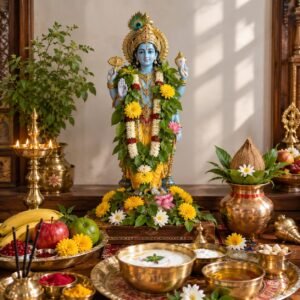
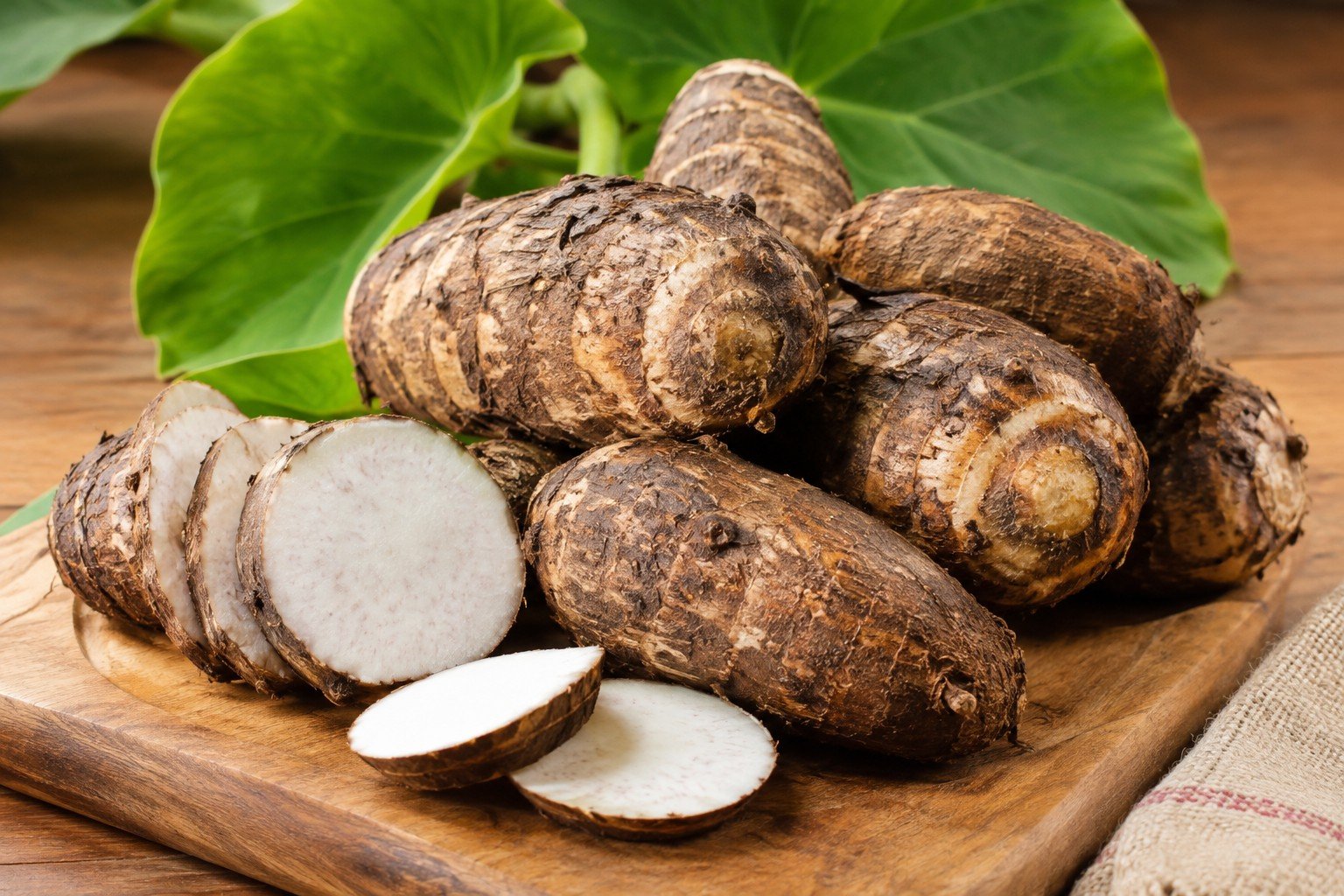
As Radha Ashtami approaches, devotees prepare different traditional foods and bhog offerings for Shri Radha Rani. Among these, Arbi Sabji (अरबी की सब्जी) has a special connection with the devotional traditions of Braj.
Many devotees have heard that Arbi is Radha Rani’s favourite sabji and wonder why this simple vegetable is offered to Shri Ji.
But is it actually mentioned in Hindu scriptures that Radha Rani loved Arbi?
The answer is a little more nuanced. Arbi being offered to Radha Rani is associated with Braj’s local devotional traditions and bhog practices. There are also different stories and beliefs explaining this connection. However, there is no widely established scriptural statement that definitively says, “Arbi was Radha Rani’s favourite vegetable.”
So, let us understand the tradition and why Arbi is considered special in some Radha Rani bhog traditions.
Why Is Arbi Offered to Radha Rani?
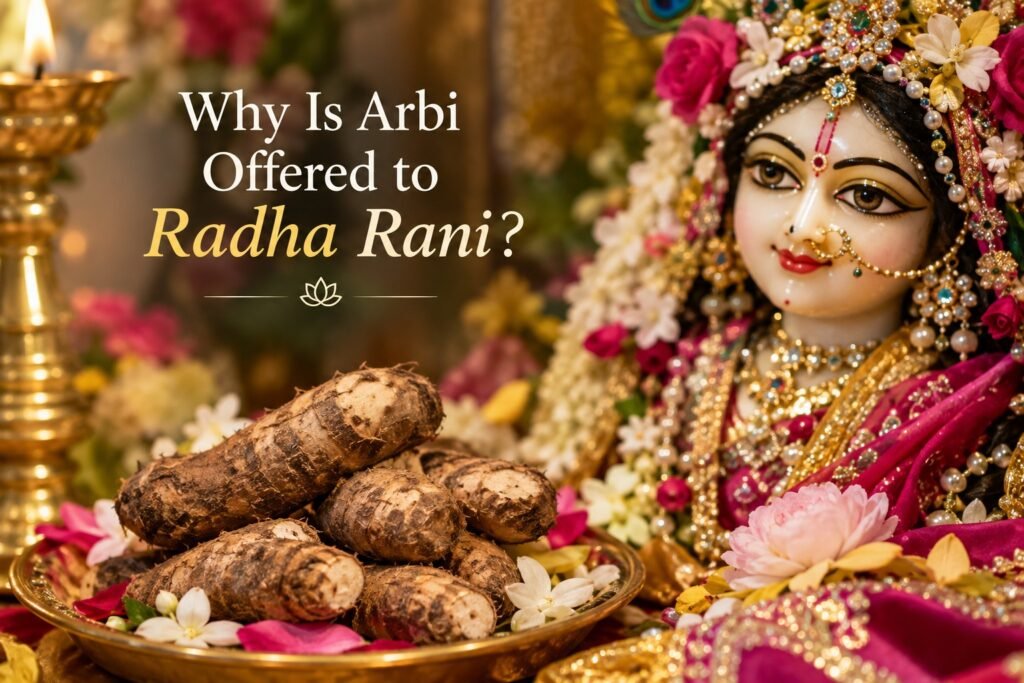
Arbi is a simple root vegetable that has been part of traditional Indian cooking for generations. In the Braj region, certain simple homemade dishes are associated with offerings made to Shri Radha and Krishna.
Arbi, particularly preparations such as Dahi Arbi, is considered by devotees to be an appropriate bhog for Radha Rani.
During occasions such as Radha Ashtami, some devotees prepare Arbi Sabji and offer it to Shri Radha Rani with devotion before taking it as prasad.
The importance is therefore not simply the vegetable itself. In bhakti traditions, the love, devotion and भावना (bhav) with which food is offered are considered important.
Is Arbi Really Radha Rani’s Favourite Sabji?
This is one of the most commonly asked questions.
You may find stories online saying that Radha Rani especially liked Arbi or explaining a particular reason behind her connection with this vegetable. These stories are part of the oral and local devotional traditions associated with Braj.
However, these different versions should not automatically be presented as facts from Hindu scriptures.
There is a difference between:
Scriptural teaching: Something directly supported by recognised religious texts.
Braj tradition: A practice, story or belief passed through local devotional traditions, temples, families and oral storytelling.
The association of Arbi with Radha Rani’s bhog is best described as a Braj devotional tradition, rather than saying that scripture definitively declares Arbi to be Radha Rani’s favourite vegetable.
Why Is Arbi Special During Radha Ashtami?
Radha Ashtami is celebrated as the appearance day of Shri Radha Rani. Devotees visit temples, perform puja, sing devotional songs and prepare different offerings.
Food prepared at home can also become part of the celebration.
In some Braj traditions, Arbi Sabji or Dahi Arbi is prepared as bhog for Radha Rani. Devotees may prepare it with simple ingredients and offer it to Shri Ji before distributing it as prasad.
This makes Arbi particularly interesting around Radha Ashtami because people searching for traditional bhog ideas may come across this Braj tradition.
Dahi Arbi – A Traditional Preparation
One popular preparation associated with Arbi bhog is Dahi Arbi.
The dish combines cooked Arbi with yogurt and traditional Indian spices. Depending on the household and tradition, the recipe can vary.
A simple preparation may include:
- Arbi
- Fresh curd
- Cumin
- Rock salt or regular salt, according to the occasion
- Ginger
- Green chilli, if suitable
- Fresh coriander
- A small amount of oil or ghee
For a devotional offering, devotees may follow the food rules of their particular tradition and prepare the bhog accordingly.
After preparing the food, it can be offered to Radha Rani with prayer and devotion.
What Is the Significance of Offering Food to Radha Rani?
In Hindu devotional traditions, offering food to the deity is commonly known as bhog.
The idea is not simply to prepare an expensive or elaborate dish. Devotees offer food with shraddha (faith), prem (love) and bhakti (devotion).
A simple homemade dish can therefore hold deep emotional and spiritual significance for a devotee.
This is also why traditional bhog dishes can differ from one region, temple or family tradition to another.
What matters to devotees is the feeling with which the offering is made.
Can You Offer Arbi Sabji to Radha Rani at Home?
Yes, devotees who follow this tradition can prepare Arbi Sabji at home and offer it to Radha Rani.
A simple way to do this is:
- Clean and cook the Arbi properly.
- Prepare the sabji according to your family or devotional tradition.
- Keep the preparation clean and suitable for bhog.
- Place it before Radha Rani or your home deity.
- Offer it with a simple prayer and devotion.
- After the offering, accept it as prasad.
If you follow a particular Vaishnav or temple tradition, it is better to follow the food and bhog practices prescribed by that tradition.
Why Do People Search for Arbi Bhog on Radha Ashtami?
Radha Ashtami is especially important in Barsana and the wider Braj region, where Shri Radha Rani is deeply worshipped.
As devotees prepare for the festival, searches for traditional bhog, prasad and recipes increase. Arbi becomes particularly interesting because of its association with certain Braj devotional practices.
This does not mean that every Radha Rani temple or every Vaishnav family necessarily offers Arbi.
Bhog traditions can differ between temples, communities and families.
Therefore, it is better to understand Arbi as one traditional offering associated with Radha Rani in parts of Braj, rather than claiming it is universally prescribed.
The Devotional Meaning Behind Arbi Bhog
One beautiful aspect of bhakti is that devotion does not always require something elaborate.
Arbi is an ordinary vegetable found in many Indian kitchens. When prepared with devotion and offered to the deity, however, it becomes part of a devotee’s spiritual practice.
For devotees who follow the Braj tradition of offering Arbi to Radha Rani, the dish carries a special emotional connection with Shri Ji.
The focus is ultimately on bhav — the loving devotional feeling behind the offering.
Is There a Scriptural Story About Radha Rani and Arbi?
There are different stories and explanations circulating about Radha Rani and Arbi.
However, these stories should be treated carefully.
There is no single universally accepted scriptural account establishing one specific story as the reason Radha Rani loved Arbi.
Some explanations belong to local folklore, oral traditions or devotional storytelling. Such traditions can be culturally and spiritually meaningful without necessarily being direct quotations or teachings from scripture.
Therefore, when discussing Radha Rani and Arbi, it is more accurate to say:
“According to a Braj devotional tradition…”
rather than:
“According to Hindu scriptures…”
unless a specific scriptural source can be provided.
Radha Ashtami Bhog: Can Arbi Be Included?
Yes. If your family tradition includes Arbi as an offering, you can prepare it for Radha Ashtami bhog.
Some devotees may prepare Dahi Arbi, while others may prepare a simple Arbi Sabji according to their household’s traditional method.
The exact bhog menu can vary, and there is no need to believe that one particular dish is compulsory for every devotee.
The most important part is to make the offering with cleanliness, devotion and श्रद्धा.
Frequently Asked Questions
Is Arbi Radha Rani’s favourite vegetable?
Arbi is considered a special bhog associated with Radha Rani in some Braj devotional traditions. However, there is no widely established scriptural statement that definitively identifies Arbi as Radha Rani’s favourite vegetable.
Why is Arbi offered to Radha Rani?
Arbi is offered as bhog in some Braj traditions connected with Shri Radha. The practice is especially discussed around Radha Ashtami.
Can we offer Arbi Sabji to Radha Rani at home?
Yes. Devotees who follow this tradition can prepare Arbi Sabji or Dahi Arbi and offer it to Radha Rani with devotion.
What Arbi dish is offered to Radha Rani?
Dahi Arbi is one preparation associated with this tradition, although recipes and bhog practices can vary between families and devotional traditions.
Is Arbi mentioned as Radha Rani’s favourite in scripture?
There is no widely established scriptural statement that specifically says Radha Rani’s favourite vegetable was Arbi. The association is better understood as a regional Braj devotional tradition.
Can Arbi be offered during Radha Ashtami?
Yes, devotees who follow this tradition may prepare Arbi and offer it as bhog during Radha Ashtami.
What is the most important part of Radha Rani bhog?
The devotional feeling, cleanliness and sincerity behind the offering are central to the practice. Different families and traditions may have different bhog preparations.
Final Thoughts
Arbi Sabji has a special place in some Braj traditions of offering bhog to Radha Rani, which is why many devotees prepare Arbi, especially around Radha Ashtami.
At the same time, the popular statement that “Arbi is definitely Radha Rani’s favourite vegetable” should be understood as a devotional tradition rather than presented as an established scriptural fact.
Whether it is a simple Arbi Sabji or Dahi Arbi, devotees can offer it to Shri Radha with prem, shraddha and bhakti.
For devotees, the beauty of bhog is not only in the food being offered, but in the love with which it is prepared and offered to Shri Radha Rani.